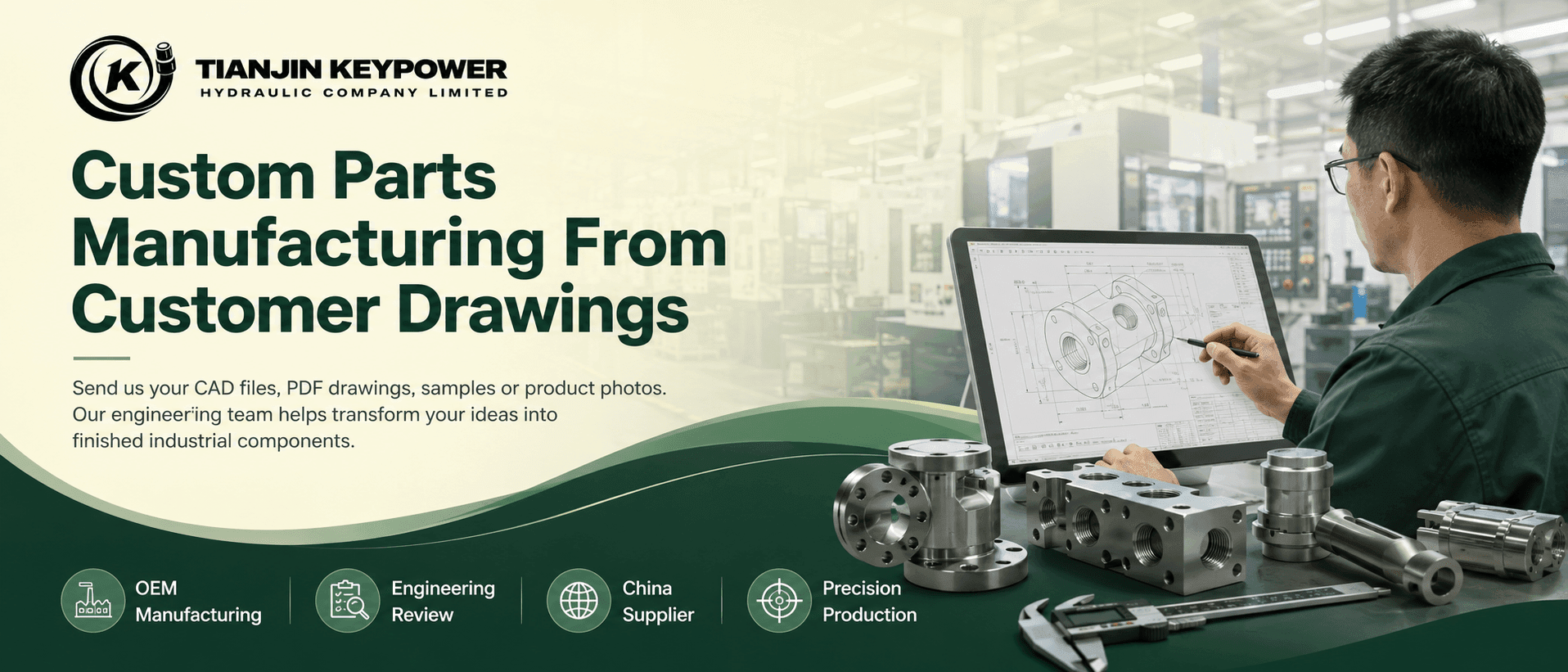
Custom Parts Manufacturing From Customer Drawings
Send us your CAD files, PDF drawings, samples or product photos. Our engineering team reviews your requirements and helps transform your design into finished industrial components.
From precision CNC machined parts and hydraulic fittings to welded assemblies and custom metal components, Power Hydraulic supports drawing-based manufacturing for OEMs, machinery manufacturers, maintenance companies and industrial buyers worldwide.
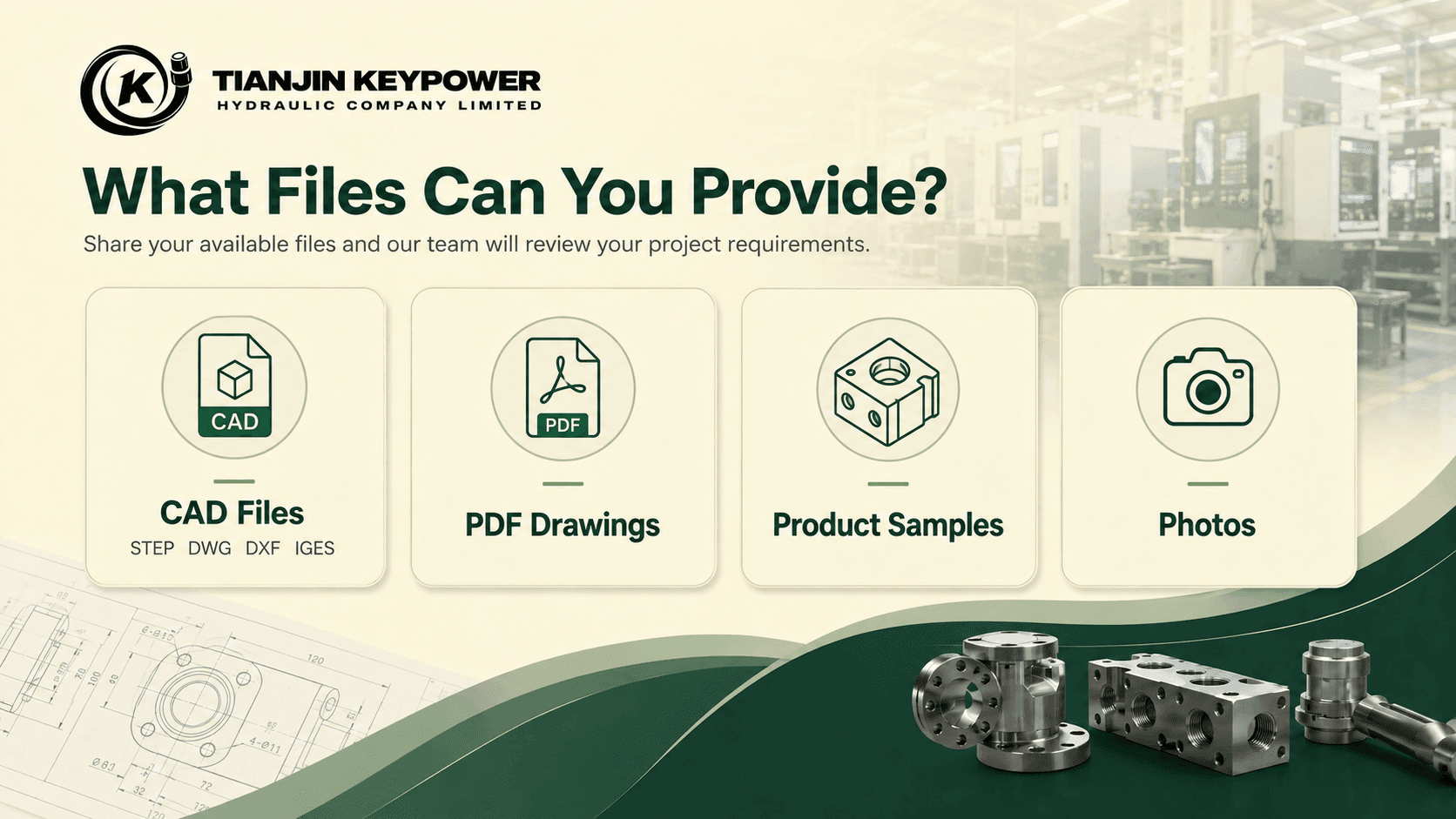
CAD Files
We accept common engineering file formats for custom component evaluation, including:
- STEP
- STP
- DWG
- DXF
- IGES
- IGS
3D CAD files help us understand component geometry, while 2D drawings provide important information about tolerances, threads, surface finishes and other manufacturing requirements.
Microcopy:
Best for: Complete custom part development and quotation.
PDF Drawings
A clear engineering drawing often provides everything we need to begin a manufacturing review.
Your drawing should include as much information as possible, such as:
- Critical dimensions
- Tolerances
- Material
- Thread specifications
- Surface finish
- Surface treatment
- Quantity
- Special inspection requirements
Microcopy:
Best for: Made-to-drawing CNC and OEM components.
Product Samples
If the original drawing is unavailable, an existing physical sample can help us evaluate the part.
Our team can review:
- Overall geometry
- Critical dimensions
- Threads
- Connection interfaces
- Material requirements
- Worn or damaged areas
We recommend providing application information together with the sample, especially when wear may have changed the original dimensions.
Microcopy:
Best for: Replacement parts and discontinued components.
Photos
Photos can provide a useful starting point when drawings and samples are not immediately available.
Send clear images from multiple angles and include any dimensions, part numbers or application information you know.
Our team can then determine what additional information we need before quotation or production.
Microcopy:
Best for: Initial project evaluation.
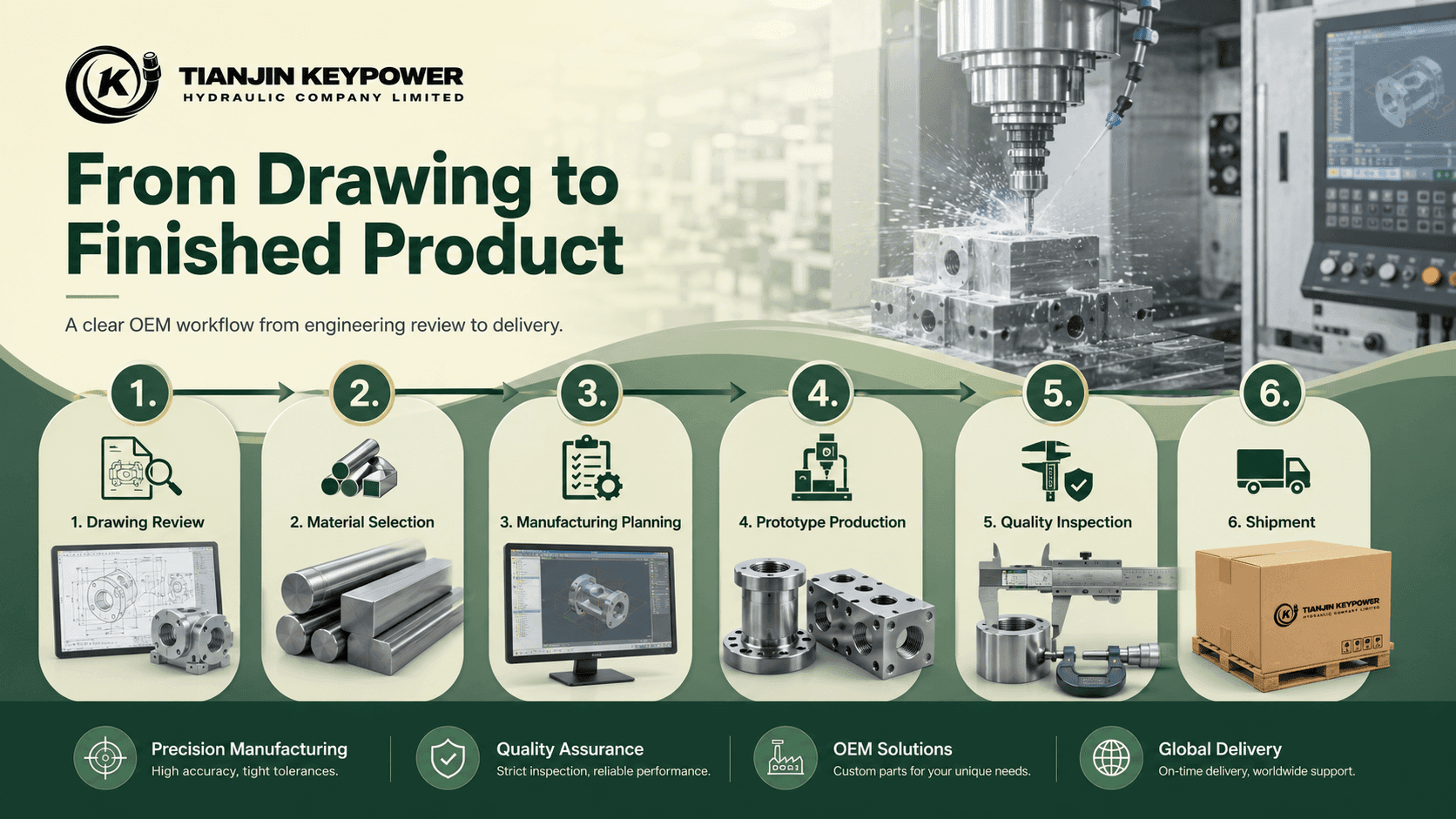
01. Drawing Review
Our engineering team reviews your drawing, CAD model, sample or technical information.
We focus on:
- Component geometry
- Critical dimensions
- Tolerances
- Threads
- Sealing surfaces
- Machining feasibility
- Assembly interfaces
If we identify unclear dimensions or conflicting specifications, we discuss them with you before production.
02. Material Selection
We confirm the required material according to your drawing and application.
Common options include:
- Stainless steel
- Carbon steel
- Alloy steel
- Aluminum
- Brass
Material selection should consider strength, corrosion resistance, wear, weight, machinability and operating conditions.
03. Manufacturing Planning
We determine a suitable production process according to the part geometry and quantity.
The manufacturing plan may involve:
- CNC turning
- CNC milling
- Drilling
- Boring
- Thread machining
- Welding
- Assembly
- Surface treatment
Planning the process before machining helps improve consistency and avoid unnecessary operations.
04. Prototype Production
For new or critical custom components, customers can begin with prototype or small-batch production.
A prototype allows you to check:
- Installation
- Dimensions
- Thread compatibility
- Mating surfaces
- Assembly fit
- Overall functionality
After you confirm the design, we can prepare repeat production according to the approved specification.
05. Quality Inspection
We inspect critical features according to the drawing and confirmed project requirements.
Depending on the component, inspection may include:
- Overall dimensions
- Bore diameters
- Hole locations
- Thread dimensions
- Critical tolerances
- Surface condition
- Machined interfaces
- Visual inspection
Please mark important dimensions clearly on your drawing if they require special attention.
06. Product Samples
After inspection and order confirmation, we prepare the components for international shipment.
We focus on suitable packaging for machined metal products so that surfaces, threads and precision features remain protected during transportation.
For repeat projects, confirmed drawings and specifications provide the basis for future orders.
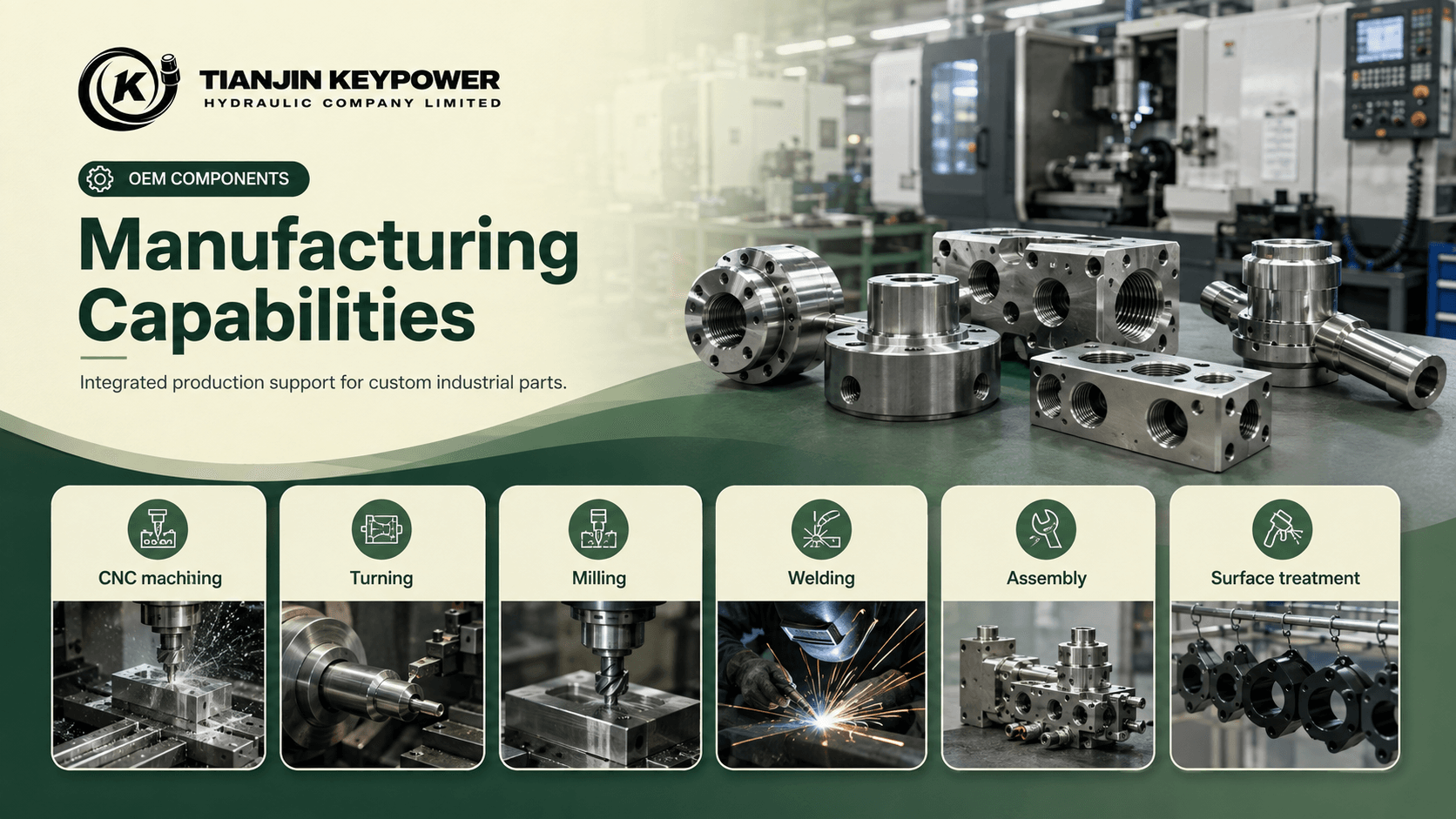
CNC Machining
We manufacture precision metal components according to customer drawings and CAD files.
Typical CNC parts include:
- Hydraulic adapters
- Fittings
- Flanges
- Manifold blocks
- Bushings
- Sleeves
- Shafts
- Pins
- Connectors
- Machine replacement parts
- Custom housings
CNC Turning
We inspect critical features according to the drawing and confirmed project requirements.
Depending on the component, inspection may include:
- Overall dimensions
- Bore diameters
- Hole locations
- Thread dimensions
- Critical tolerances
- Surface condition
- Machined interfaces
- Visual inspection
Please mark important dimensions clearly on your drawing if they require special attention
CNC Milling
CNC milling allows us to manufacture parts with:
- Multiple holes
- Pockets
- Slots
- Flat surfaces
- Mounting interfaces
- Cross passages
- Complex external geometry
Typical applications include manifold blocks, brackets, plates, valve bodies and custom machine components.
Welding
Some custom projects require welded structures or connections in addition to machining.
We can evaluate parts involving:
- Welded fittings
- Metal hose connections
- Tube components
- Custom assemblies
- Fabricated metal parts
The manufacturing method depends on the material, geometry and application.
Assembly
For suitable projects, we can combine multiple components into a finished or semi-finished assembly.
This can reduce the number of suppliers involved in your project and simplify purchasing.
Assembly requirements should appear clearly on the drawing or project specification.
Surface Treatment
Different materials and applications may require additional surface finishing.
Depending on the project, options may include:
- Zinc plating
- Nickel plating
- Passivation
- Anodizing
- Black oxide
- Polishing
- Brushing
- Customer-specified coating
We confirm surface requirements before production.
Materials for Custom Parts
Stainless Steel
Suitable for corrosion-resistant components, hydraulic equipment, marine applications, process systems and demanding industrial environments.
Carbon Steel
A practical choice for many mechanical and hydraulic components that require strength and cost efficiency.
Alloy Steel
Suitable for applications that require additional strength, hardness or wear resistance.
Aluminum
A lightweight and machinable material for automation equipment, housings, fixtures and other industrial components.
Brass
Commonly selected for fittings, adapters and suitable fluid connection applications.
Supporting Copy
The final material should match the technical specification and service conditions rather than appearance or cost alone.
If you are unsure which material suits your application, provide the operating conditions during the engineering review.
Who Uses Our Custom Manufacturing Service?
OEM Manufacturers
Custom parts for new machines, equipment and product assemblies.
Hydraulic Equipment Companies
Adapters, fittings, blocks, connections and other hydraulic components.
Hydraulic Equipment Companies
Adapters, fittings, blocks, connections and other hydraulic components.
Machinery Builders
Precision parts for specialized industrial machines and production equipment.
Maintenance Companies
Replacement components for worn, damaged or obsolete equipment.
Engineering Companies
Prototype and project-based components according to technical drawings.
Frequently Asked Questions
Can you manufacture a custom part directly from my drawing?
Yes. Send us your 2D drawing, 3D CAD model or technical specification. Our team will review the material, dimensions, tolerances and manufacturing requirements before quotation.
What CAD file formats can I send?
You can send common formats such as STEP, STP, DWG, DXF, IGES and IGS. PDF technical drawings and clear product images can also help us evaluate your project.
What if I do not have a drawing?
You can send an existing sample, photographs and available dimensions. We can review the information and determine what additional details we need.
Do you accept prototype orders?
Yes. Many custom manufacturing projects start with one or several prototypes before moving to small-batch or repeat production.
Can you manufacture a replacement part from an existing sample?
Yes. Sample-based manufacturing can help reproduce obsolete or difficult-to-source components. We also recommend providing application information because wear may have changed some dimensions of the original part.
Can you manufacture hydraulic components?
Yes. We support custom hydraulic adapters, fittings, manifolds, connectors and other precision machined components according to customer specifications.
What information helps you quote faster?
A complete drawing with material, quantity, tolerances and surface requirements provides the best starting point. Application information also helps us understand critical features.
Can you manufacture small quantities?
Yes. We can evaluate prototype, low-volume and repeat-production projects according to component complexity.
Custom CNC Machine Components
Customer
Bell Truck (USA)
Application
CNC Machinery
Capability
Precision Machining
OEM Production
Custom Components


Custom Industrial Components From Customer Drawings
Customer
European Industrial Customer
Application
Industrial Equipment
Capability
Drawing Review
Prototype Production
Small Batch Manufacturing


