
CNC Machining Materials Guide: How to Choose the Right Material for Custom Parts
Choosing a material for CNC machining is not simply a matter of deciding between aluminum and stainless steel.
In real manufacturing projects, material selection affects almost every part of the final component: strength, corrosion resistance, dimensional stability, machining time, tool wear, surface finish, weight, production cost, and long-term service life.
For engineers, purchasing teams, and OEM companies, the challenge is often not finding a material that can be machined. The real challenge is finding the material that provides the right balance between performance and manufacturing cost.
From the perspective of a manufacturer reviewing customer drawings, we often find that material decisions fall into three different situations.
Some drawings already specify an exact material grade.
Others only specify a general material, such as “stainless steel” or “aluminum.”
And in many replacement-part or reverse-engineering projects, the customer has a physical sample but does not know exactly what material was originally used.
These situations require different approaches.
A good CNC supplier should therefore do more than simply manufacture the dimensions shown on a drawing. The supplier should understand how CNC machining materials behave during manufacturing and whether the selected material is appropriate for the component’s actual working conditions.
This guide explains the most common materials used for custom CNC parts and the factors engineers should consider before placing an order.

Why Material Selection Matters in CNC Machining
Material selection directly affects both component performance and manufacturing efficiency.
A material may perform extremely well in service but be expensive and difficult to machine. Another material may be inexpensive and easy to machine but unsuitable for high temperatures, aggressive chemicals, or high mechanical loads.
For this reason, material selection should always consider the complete application rather than only the drawing.
This is why engineers usually evaluate several factors together:
- mechanical load;
- operating temperature;
- environmental exposure;
- corrosion risk;
- component weight;
- dimensional tolerance;
- surface finish;
- expected production volume;
- machining complexity;
- budget.
A material that looks more expensive at the purchasing stage can sometimes reduce maintenance costs over the lifetime of the equipment.
At the same time, specifying a premium material where it is not required may unnecessarily increase both material and machining costs.
Good metal material selection is therefore an engineering decision as much as a purchasing decision.
Common Materials for CNC Machined Components
A wide range of metals can be processed using CNC turning, milling, and other machining processes.
For industrial OEM components, several material groups are especially common.
Stainless Steel
Stainless steel is widely used for custom machined components where strength, corrosion resistance, and durability are important.
Common applications include:
- hydraulic components;
- food-processing machinery;
- chemical equipment;
- marine components;
- pumps and valves;
- fittings;
- precision shafts;
- industrial fasteners;
- machinery operating in humid environments.
One of the biggest advantages of stainless steel CNC machining is corrosion resistance.
However, stainless steel should not be treated as one single material.
Different stainless steel grades have significantly different machining properties and performance characteristics.
304 Stainless Steel
304 is one of the most widely used stainless steel grades.
It offers a useful combination of corrosion resistance, mechanical strength, and general availability.
Typical applications include equipment components, brackets, housings, fittings, and general industrial parts.
For many ordinary industrial environments, 304 provides sufficient corrosion resistance.
However, its machining characteristics are different from those of carbon steel or free-machining metals. Proper cutting tools, feeds, speeds, and cooling conditions are important because stainless steel can work-harden during machining.
316 Stainless Steel
316 stainless steel is frequently selected where improved corrosion resistance is required.
The addition of molybdenum provides better resistance in certain chloride-containing and aggressive environments.
It is commonly considered for:
- marine equipment;
- chemical processing components;
- food production machinery;
- outdoor equipment;
- parts exposed to salt or corrosive liquids.
When customers ask whether they should choose 304 or 316, the answer should normally depend on the operating environment rather than simply choosing the more expensive material.
If a component works indoors under mild conditions, 316 may offer little practical advantage.
If corrosion is a major concern, however, the additional material cost can be justified.
Manufacturing Considerations
Stainless steel generally requires more machining effort than aluminum and many carbon steels.
It may lead to:
- slower cutting speeds;
- increased cutting-tool wear;
- greater heat generation;
- longer machining cycles.
Therefore, changing a drawing from carbon steel to stainless steel can increase manufacturing cost even if the geometry remains the same.
The cost difference comes not only from raw material price, but also from machining time.
Carbon Steel
Carbon steel remains one of the most practical materials for industrial CNC manufacturing.
It is widely used in machine components, shafts, brackets, fixtures, adapters, mechanical replacement parts, and structural components.
The main advantages of carbon steel include:
- good strength;
- broad availability;
- relatively competitive cost;
- good machinability for many grades;
- suitability for heat treatment;
- wide range of mechanical properties.
Different steel grades can be selected depending on required strength, hardness,s and manufacturing requirements.
Compared with stainless steel, carbon steel generally has lower natural corrosion resistance.
This does not necessarily mean it is unsuitable for industrial applications.
Many carbon steel CNC machined parts are protected through additional surface treatments such as plating, black oxide, painting or other coatings.
This creates another important engineering consideration.
Sometimes a carbon steel component with an appropriate surface treatment is more economical than manufacturing the entire part from stainless steel.
For components working in non-aggressive environments, this can provide a good balance of cost and performance.
For heavily corrosive applications, however, a coating may not provide the same long-term reliability as selecting an inherently corrosion-resistant material.
Aluminum
This is one of the most popular CNC machining materials, especially when low weight and efficient machining are important.
The biggest advantage of aluminum is its high strength-to-weight ratio.
It is much lighter than steel and is generally easier to machine.
This can reduce both component weight and manufacturing time.
Aluminum CNC Parts and Machining Efficiency
For many designs, aluminum CNC parts can be machined at higher cutting speeds compared with stainless steel.
This is especially useful when parts have:
- multiple pockets;
- complex profiles;
- deep cavities;
- large quantities of material removal.
Lower cutting forces can also make aluminum suitable for thin-wall components when appropriate machining strategies are used.
However, not all aluminum grades have identical properties.
Strength, corrosion resistance, and machining performance vary significantly between alloys.
One commonly used alloy is 6061 aluminum because it provides a practical balance between strength, corrosion resistance,ce and machinability.
Other alloys may be selected when higher mechanical properties are required.
When Aluminum Is Not the Best Choice
Aluminum should not automatically be selected simply because it is lightweight.
For highly loaded shafts, wear surfaces, high-temperature components, or parts requiring very high hardness, steel may be more appropriate.
An experienced CNC supplier should therefore review the application before recommending a material change from steel to aluminum.
Brass and Other Materials
Brass is another useful material for certain custom machined components.
It is commonly found in:
- fittings;
- connectors;
- valves;
- electrical components;
- instrumentation;
- fluid-control components.
Brass generally offers good machinability and useful corrosion resistance.
Its machining characteristics can make it attractive for precision-turned components, especially when large quantities are required.
Depending on the project, other machinable materials may include bronze, copper, tool steels, and engineering alloys.
The important point is that material selection should be based on application requirements rather than selecting a material solely because it is familiar.
CNC Machining Material Comparison
The following table provides a general comparison for industrial buyers.
| Material | Strength | Corrosion Resistance | Machinability | Weight | Typical Applications |
|---|---|---|---|---|---|
| Aluminum | Medium | Good | Excellent | Low | Automation, housings, fixtures, lightweight parts |
| Carbon Steel | High | Low without protection | Good | High | Shafts, machinery parts, brackets, OEM components |
| 304 Stainless Steel | High | Very Good | Medium | High | Industrial equipment, fittings, food machinery |
| 316 Stainless Steel | High | Excellent | Medium | High | Marine, chemical and corrosive environments |
| Brass | Medium | Good | Excellent | Medium/High | Fittings, valves, connectors, precision turned parts |
This table should be treated as a starting point rather than a final engineering specification.
Exact performance always depends on material grade, geometry, heat treatment, manufacturing processes,s and working conditions.
How Application Affects Material Choice
When our manufacturing team reviews a new custom CNC project, the drawing provides only part of the information required.
Application information can be equally important.
Two parts with almost identical drawings may require completely different materials because they work in different environments.
Consider a simple CNC-machined adapter.
This is why we recommend that customers provide basic application information whenever possible.
A CNC manufacturer does not necessarily need confidential details about the complete machine.
Usually, information about the operating environment is enough to identify potential material risks.
Strength
Strength is usually one of the first material properties considered.
However, the word “strength” can refer to several different characteristics.
Depending on the component, engineers may evaluate:
- tensile strength;
- yield strength;
- hardness;
- fatigue resistance;
- impact resistance;
- wear resistance.
A heavily loaded shaft has different requirements from an aluminum control-panel housing.
Using high-strength material for every component would be inefficient and expensive.
The material should match the actual mechanical load.
Geometry also matters.
A poorly designed component does not automatically become reliable simply because it is made from stronger material.
Material selection and component design need to work together.
Corrosion Resistance
For many industrial applications, corrosion resistance has a direct effect on service life.
A part exposed to moisture, coolant, chemicals, or outdoor weather may experience corrosion even if its mechanical load is relatively low.
This is why corrosion-resistant materials such as stainless steel are frequently specified for equipment working in demanding environments.
However, the actual environment must be understood.
There is an important difference between:
- occasional exposure to water;
- permanent immersion;
- saltwater exposure;
- hydraulic oil;
- chemical solutions;
- high-temperature fluids.
Different environments require different approaches.
When customers request stainless steel without specifying the service environment, it may be useful for the supplier to ask why stainless steel was selected.
Sometimes there is a clear technical reason.
In other cases, a more economical material could achieve the same performance.
Machinability
Machinability describes how easily and efficiently a material can be cut to the required geometry and surface condition.
This property has a direct effect on CNC manufacturing cost.
A material with good machinability can generally be processed faster with lower tool wear.
Materials that are difficult to machine may require:
- lower cutting speeds;
- specialized tooling;
- additional coolant;
- more tool changes;
- longer cycle times;
- more careful process planning.
This is one reason material cost alone does not determine the final component price.
For example, two materials with similar raw material prices may produce very different CNC machining quotations because one requires significantly longer machining time.
For complex precision machining projects, this difference becomes even more important.
Weight
Weight can be critical in automation, robotics, transportation equipment, and moving assemblies.
Replacing steel with aluminum can reduce part weight substantially.
However, engineers must confirm that stiffness, thread strength, wear resistance, and overall structural performance remain acceptable.
A lighter material is not automatically a better engineering choice.
Weight should be considered together with strength and component geometry.
How Geometry and Material Work Together
One aspect of material selection that buyers sometimes overlook is the relationship between material and part geometry.
A drawing designed for steel may not always perform identically if manufactured from aluminum.
Likewise, changing from aluminum to stainless steel may affect machining methods and production cost.
Thin walls, deep holes, narrow slots, and long shafts all respond differently depending on material.
For example, thin components may distort because of internal material stress or machining forces.
Long shafts may require specific support during turning.
Deep pockets may create chip evacuation problems.
Tight tolerances may require additional finishing passes or controlled machining sequences.
This is why material changes should ideally be reviewed together with the drawing.
Material Selection for Low-Volume and Small-Batch Production
Material selection becomes especially important in small-batch manufacturing.
For large-volume production, custom tooling and highly optimized processes can sometimes justify more complicated manufacturing methods.
For prototypes and small batches, the strategy is different.
Customers usually need:
- lower initial investment;
- fast development;
- flexible quantities;
- practical materials;
- reliable machining.
In these projects, standard and readily available material grades can often reduce both lead time and cost.
For more information about low-volume production, see our page on:
This approach is especially useful when validating a new machine component before moving to larger production quantities.
Material Selection Mistakes to Avoid
Material errors can be expensive because they are often discovered after machining is already complete.
One common mistake is specifying only a broad material category.
For example:
Stainless steel
is not always sufficient.
There are many stainless steel grades with different mechanical, corrosion, and machining characteristics.
Another common problem is copying the material specification from an old drawing without considering whether the current application has changed.
This frequently occurs with replacement mechanical parts.
A machine may have been modified, operating speed may have increased, or the component may now work in a different environment.
The original material specification may no longer be optimal.
A third mistake is choosing material based only on raw material price.
The final component cost includes much more than the raw material.
Machining time, tooling, setup, inspection, heat treatment, and finishing can all influence the final price.
Finally, buyers should avoid selecting an unnecessarily expensive material simply because it appears safer.
Over-specification increases product cost without necessarily improving practical performance.
Choosing Materials for Replacement and Reverse-Engineered Parts
Material selection is particularly interesting when manufacturing a replacement part from an existing sample.
Sometimes the customer has an old mechanical component but no usable engineering drawing.
In this situation, the manufacturing process may begin with dimensional measurement and material identification.
However, reproducing the old component exactly is not always the only objective.
The more useful question is:
Why did the original part fail?
If a part experienced excessive corrosion, simply copying the original material may reproduce the same problem.
If the original component failed because of wear, a different material or heat treatment may be worth evaluating.
The customer needs only a short-term replacement for obsolete equipment, manufacturing cost may become a higher priority.
This is where practical manufacturing discussion becomes important.
Our approach to custom mechanical components is to consider both the physical sample and the actual operating requirement rather than treating reverse engineering as simple copying.
You can learn more about this manufacturing process through our Custom Parts From Drawing service:
How Material Selection Affects CNC Machining Cost
When comparing quotations from different CNC suppliers, buyers sometimes find surprisingly large price differences.
Material choice can be one reason.
The machining cost of a custom component is influenced by:
Raw material cost
Some alloys are significantly more expensive than standard steels or aluminum.
Material dimensions
A component may require a much larger stock size than its final finished dimensions.
Material removal
A part machined from a solid block may require significant material removal.
Machining speed
Aluminum can often be processed considerably faster than difficult stainless steels.
Tool wear
Some materials increase cutting-tool consumption.
Tolerance
Tighter tolerance normally requires more careful machining and inspection.
Surface finish
Certain finishing requirements add additional operations.
Therefore, when requesting a quotation, buyers should ideally provide the exact material grade instead of only providing a generic description.
How to Discuss Material Requirements With Your CNC Supplier
Clear communication at the quotation stage can prevent many manufacturing problems.
When sending a drawing to a CNC supplier, we recommend including:
- Material grade, if already specified by your engineer.
- Application of the component.
- Main mechanical load or function.
- Operating temperature.
- Contact with water, oil, chemicals, or other media.
- Indoor or outdoor use.
- Surface treatment requirement.
- Required quantity.
- Critical tolerances.
- Whether alternative materials may be considered.
If the material has already been fully validated, the manufacturer should follow the specification.
If the project is still under development, indicating that alternative materials are acceptable gives the CNC manufacturer more flexibility to suggest a practical manufacturing solution.
Working From Customer Drawings
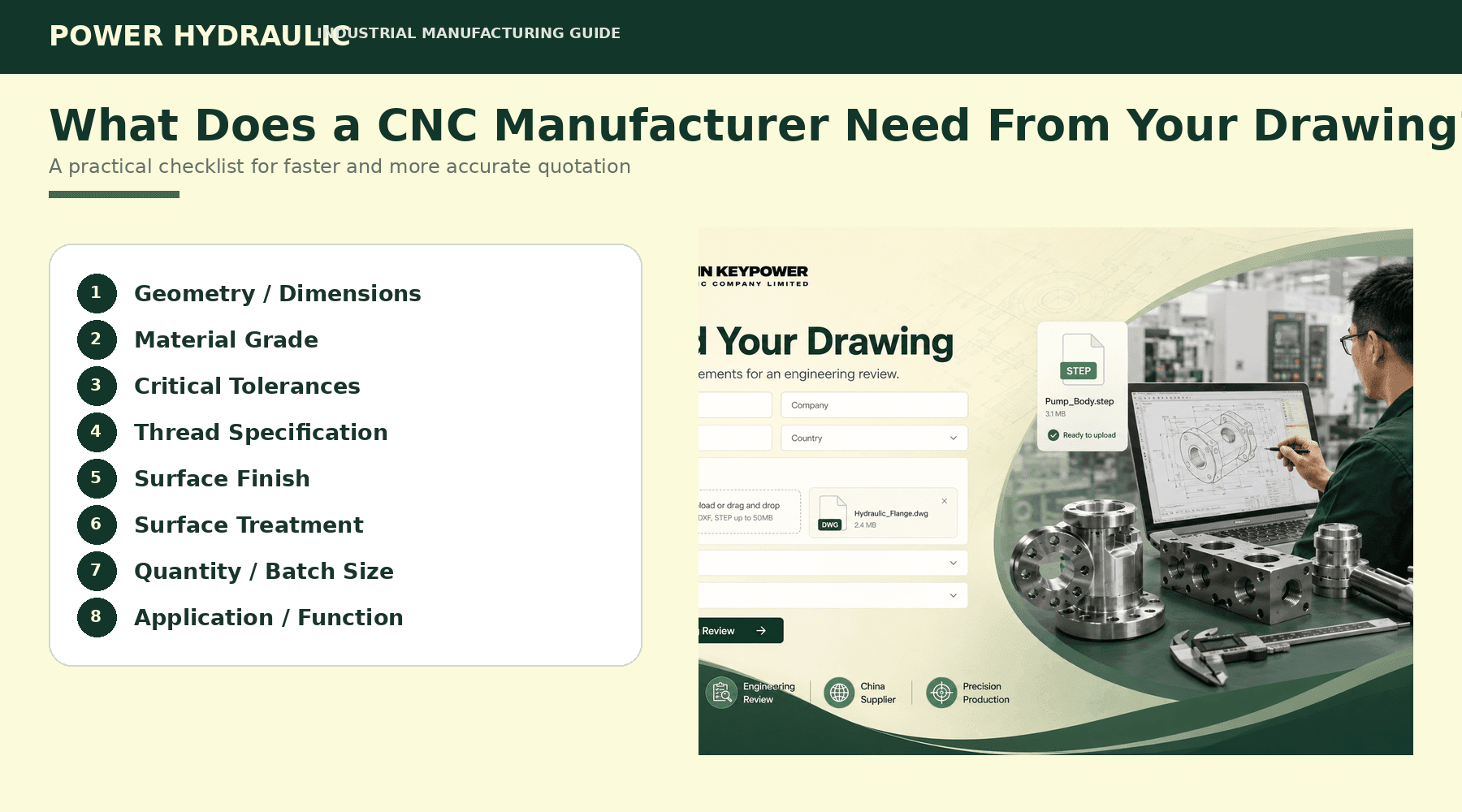
For custom manufacturing projects, the drawing remains the most important technical reference.
A complete drawing should clearly identify:
- dimensions;
- tolerances;
- material;
- threads;
- surface roughness;
- surface treatment;
- special inspection requirements.
STEP or other 3D CAD files are highly useful for understanding geometry, while 2D engineering drawings remain important for tolerances and specifications.
Our manufacturing workflow typically starts by reviewing the drawing and identifying whether there are features that may affect machining cost or manufacturing feasibility.
This may include difficult internal corners, extremely deep holes, thin walls, or unusually tight tolerances.
The objective is not to redesign the customer’s component without permission.
The objective is to identify potential manufacturing issues before production begins.
For more information, visit:
Material Selection for OEM Components
OEM projects often have different requirements from one-time replacement components.
The material must not only perform correctly.
It must also be:
- consistently available;
- suitable for repeat manufacturing;
- economically practical;
- compatible with the customer’s quality requirements.
A material that works well for one prototype may not always be the best choice for producing hundreds or thousands of components.
Supply consistency becomes increasingly important as production volume grows.
For this reason, OEM material selection should consider long-term procurement as well as engineering performance.
Learn more about our manufacturing capabilities for:
and
A Practical Material Selection Example
Consider a custom CNC bracket for industrial machinery.
The initial drawing specifies stainless steel.
The first question should not necessarily be:
“Can we machine stainless steel?”
Of course it can be machined.
A more useful engineering discussion is:
Why is stainless steel required?
If the bracket operates outdoors or around coolant, the answer may be obvious.
But if it operates inside a dry machine enclosure and does not experience severe loading, carbon steel with surface treatment may be sufficient.
Alternatively, if reducing moving mass is important, aluminum may be considered.
The correct answer depends on the application.
This is why technical communication between customer and manufacturer can create value before machining even begins.
FAQ
What are the most common CNC machining materials?
Common materials include aluminum, carbon steel, stainless steel, brass, bronze, and other engineering alloys. The best material depends on mechanical load, corrosion resistance, temperature, weight, and machining requirements.
Is aluminum easier to machine than stainless steel?
In general, aluminum offers better machinability and can usually be processed at higher cutting speeds. Stainless steel often requires slower machining and more careful tool selection.
However, exact machining conditions depend on the specific alloy and component geometry.
Should I choose 304 or 316 stainless steel?
304 is widely used for general industrial applications.
316 is often selected where stronger corrosion resistance is required, particularly in certain chemical, marine, and chloride-containing environments.
The application should determine the material rather than assuming 316 is always necessary.
Which material is best for custom CNC machined parts?
There is no single best material.
The correct choice depends on strength, corrosion resistance, temperature, weight, wear, machining cost, and service environment.
Can a CNC manufacturer recommend a material?
Yes, especially during product development.
However, the customer should provide application information so that any recommendation is based on actual operating conditions.
For safety-critical or highly regulated parts, material selection should always be confirmed by the responsible design engineer.
Does stainless steel CNC machining cost more?
It often does.
The raw material can be more expensive, and machining speeds may be lower than for aluminum or some carbon steels.
Tool wear and machining time can therefore increase the total component cost.
Can I change the material of an existing CNC part?
Possibly, but the change should be reviewed carefully.
Material substitutions may affect strength, stiffness, corrosion resistance, weight, threads, wear, and dimensional stability.
For replacement components, application conditions should be checked before changing material.
What information should I send for a CNC machining quotation?
Ideally, send a STEP file and engineering drawing together with material grade, quantity, tolerances, surface treatment, and application information.
If you only have a physical sample, reverse engineering and sample-based manufacturing may also be possible.
Need Help Selecting the Right Material for Your CNC Component?
Choosing the right material is one of the first important decisions in any custom machining project.
The best option is not always the strongest material, the most corrosion-resistant material, or the most expensive material.
It is the material that provides the appropriate combination of:
performance, machinability, reliability, and total manufacturing cost.
If you already have a completed engineering drawing, we can review the manufacturing requirements and prepare a quotation.
If your product is still under development, provide the application information together with your drawing and let us know whether alternative materials may be considered.
Send Your Drawing for Manufacturing Review
Please send:
STEP / DWG / DXF / PDF drawing + material requirement + quantity + application information
Our team can review the component from a manufacturing perspective and help identify a practical production solution.
Request a CNC Machining Quote →