
Metal Hose: The Ultimate Guide to Types, Materials, Selection & Applications 2026
Flexible metal hose assemblies remain an irreplaceable solution within industrial piping systems. Designed to compensate for thermal displacement, isolate mechanical vibration, accommodate minor installation misalignment, and safely convey fluids under extreme operating conditions, these components are widely specified across oil & gas, chemical processing, power generation, food processing, marine, and pharmaceutical sectors. Metal Hose Manufacturer Insights: Causes of Premature Hose Failure & Optimised Selection Solutions for Engineers | Keypower Hydraulic
After more than a decade focused on metal hose fabrication and export to Europe, Southeast Asia, the Middle East, and Latin America, our engineering team has noticed a recurring problem for global buyers. Many specification errors, premature on-site failures, and unnecessary cost overruns stem from basic misunderstandings around metal hose classification, material limits, and proper assembly design. Many clients rely on generic product data sheets without matching construction style to their actual working environment.
This comprehensive guide draws on real production cases, third-party testing experience, and decades of field feedback from our international customers. It is created to help procurement specialists, plant engineers, and project contractors navigate the full lifecycle of metal hose selection, specification, installation, and maintenance. Beyond theoretical knowledge, we share practical lessons learned from manufacturing thousands of custom corrugated metal hoses, stripwound hoses and PTFE-lined assemblies for overseas industrial projects.

1. What Exactly Is an Industrial Metal Hose Assembly?
It is critical to distinguish between a bare corrugated tube and a complete metal hose assembly. Many new overseas buyers mistakenly purchase loose corrugated tubing without matched reinforcement and fittings, which cannot be directly deployed in industrial piping.
A standard pressure-resistant metal hose assembly consists of four core components:
1. Corrugated tube body: The sealing carrier for medium transmission, manufactured via hydraulic forming or mechanical corrugation
2. Outer wire braid layer(s): Reinforcement to withstand internal working pressure and absorb axial tension
3. Ferrule / Connector transition section: Connects corrugated tube and end fittings, the highest risk zone for fatigue cracking
4. End fittings: Threaded ends, flanges, quick couplings, weld ends or sanitary connections tailored to customer piping standards
Not all metal hoses are built for pressure service. This is one of the most frequent specification mistakes we encounter during customer technical confirmation. Corrugated metal hoses are hermetically sealed for liquid, gas and steam transport. By contrast, interlocked stripwound metal hoses have gaps between spiral strips. They cannot hold internal pressure and are intended purely for cable protection, exhaust ducting or dust conveyance. Mixing up these two categories leads to severe on-site safety hazards.
From our production experience, we often remind clients to clarify one fundamental question before inquiry: Does your application require a pressure-tight sealed flexible connection, or mechanical protection only? This single judgement filters more than 40% of early-stage design errors.
Corrugated Metal Hose vs Stripwound Metal Hose: Complete Comparison
2. Core Categories of Metal Hoses & Practical Application Boundaries
2.1 Annular Corrugated Stainless Steel Metal Hose
Annular corrugated hose is our highest-volume export product. The tube blank can be either a longitudinally welded stainless steel tube or a seamless tube, processed into continuous annular corrugations. The waveform structure delivers balanced flexibility and pressure resistance. One or two layers of stainless steel wire braid are wrapped externally and mechanically crimped onto end connectors.
We select tube blank raw materials strictly based on the medium and environment. Welded tube blanks offer cost advantages for general industrial conditions, while seamless tube substrates are recommended for high-pressure, high-cycle fatigue working scenarios. During production, we control corrugation pitch, wave height, and wall thickness consistently. Minor fluctuations in these parameters will directly shorten service life under repeated bending movement.
Typical operating strengths:
– Wide temperature adaptability ranging from cryogenic service up to 450°C
– Resistant to thermal shock and continuous vibration
– Fully sealed for liquid, steam, inert gas and light hydrocarbon media
Common limitations:
Long-distance large displacement is not recommended. Excessive elongation will break the braided reinforcement and cause early leakage.
2.2 PTFE Lined Composite Metal Hose
For media with strong corrosive properties, pure stainless steel corrugated hose cannot guarantee long-term service. Our PTFE-lined metal hose solves this challenge. The structure adopts an inner extruded PTFE liner, covered by a stainless steel corrugated tube and wire braid reinforcement.
Many buyers only focus on acid and alkali resistance, yet overlook two practical details we summarised from export orders. First, PTFE liners have a maximum continuous temperature limit. Under saturated high-temperature steam, improper liner fixation will lead to liner shrinkage and detachment. Second, static build-up occurs when transporting non-conductive fluids. For petrochemical hazardous medium transportation, anti-static conductive PTFE lining must be specified. Without this treatment, static discharge creates explosion risks inside pipelines.
This product line is widely exported to chemical plants, fine chemistry workshops, and sanitary food-grade projects requiring non-contamination fluid transfer.
PTFE Lined Stainless Steel Metal Hose: Benefits & Typical Applications
2.3 Stripwound Interlocked Metal Hose
Stripwound hose is formed by continuous interlocking stainless steel metal strips. Its open interlock structure provides outstanding flexibility but zero pressure tightness. We frequently receive enquiries from clients who attempt to use stripwound hose for fluid transport, which we always advise against.
Main export applications include mechanical equipment cable shielding, vehicle exhaust pipelines, ventilation and dust removal channels. Some clients combine stripwound hose as an outer protective sheath outside corrugated assemblies to resist external mechanical abrasion on construction sites.
2.4 Single Braided vs Double Braided Reinforcement
The number of braid layers directly defines maximum allowable working pressure. Many customers simply increase working pressure requirements without considering bending cycles. We have handled after-sales cases where double braided hoses failed prematurely because the design ignored dynamic bending fatigue.
Single braid assemblies suit medium pressure and static installation. Double braided structures boost pressure resistance, but the extra layer slightly reduces overall flexibility. For dynamic circulating movement with frequent bending, our engineering team balances pressure rating and bending performance instead of blindly recommending double braided construction.
Unbraided vs Double Braided Metal Hose: What Is The Difference
3. Material Selection: Stainless Steel Grades & Real-World Trade-offs
Material selection is never a simple choice between 304 and 316L. We analyse dozens of technical sheets monthly, and many clients underestimate the influence of ambient conditions, especially chloride ion concentration in coastal and marine environments.
3.1 Stainless Steel 304
Grade 304 stainless steel remains the most cost-effective option for general industrial environments. Continuous working temperature spans -196°C to 450°C. It performs well for clean water, dry steam, general oil, and non-corrosive gas.
From a manufacturing perspective, 304 raw material supply is stable, forming and welding processes are mature, which helps control order lead time for bulk export shipments. However, we clearly warn clients: 304 suffers pitting corrosion under sustained exposure to salt mist, brine, or chloride-containing media. For offshore, coastal chemical park installation, 304 is not a long-term economical choice.
3.2 Stainless Steel 316L
316L adds molybdenum elements to improve chloride corrosion resistance, making it our primary material for marine, desalination, and chemical export projects. Low carbon content reduces carbide precipitation during high-temperature welding, lowering the risk of intergranular corrosion.
A common misunderstanding we encounter: clients assume 316L can resist all corrosive media. Strong oxidising acids and concentrated halogens still cause gradual corrosion. In such extreme conditions, we propose PTFE lining as a better solution rather than simply upgrading stainless steel grades.
304 VS 316L Stainless Steel Metal Hose: How to Make the Right Choice
3.3 Special Alloy Customisation
For ultra-high temperature, strongly corrosive working conditions, we support custom production using Inconel, Monel, and other alloy materials. These special alloys carry higher raw material costs and longer production cycles. We normally suggest customers complete small batch prototype testing before large-volume export orders to verify performance under site operating parameters.
4. Key Technical Specifications You Must Confirm Before Placing an Order
We receive hundreds of vague enquiries every month. Messages only stating “stainless steel metal hose, 2 inch” cannot support accurate quotation and safe manufacturing. To avoid technical deviation, our engineering department requires all clients to confirm the following specifications in detail:
1. Nominal inner diameter and overall assembly length
2. Medium being transported (chemical composition, concentration)
3. Continuous working temperature and peak temperature
4. Rated working pressure and required safety factor
5. Static fixed installation or reciprocating dynamic bending
6. Minimum bending radius available on site
7. End connection standard: DIN, ANSI, JIS, GB or custom drawing
8. External environment: indoor, coastal salt atmosphere, outdoor exposure, explosive hazardous area
One frequent error worth highlighting: many buyers confuse working pressure with test pressure. Our factory conducts hydraulic pressure testing at 1.5 times working pressure for every finished assembly before shipment. Burst pressure normally reaches 3~4 times rated working pressure, but this burst value cannot be used as long-term operating pressure.
How to Check Metal Hose Pressure Rating for Your Working Condition
Common End Fittings for Metal Hose Assembly: Thread, Flange, Quick Coupling
5. Industrial Application Scenarios & Verified Project Case Studies (EEAT Core)
Generic application descriptions cannot build trust for B2B industrial buyers. In this section, we share three real export project cases solved by our technical team, covering vibration fatigue failure, marine chloride corrosion, and chemical medium incompatibility — the three most common pain points in global metal hose field operation.
Case 1: Vibration Fatigue Failure Solved for European Petrochemical Compressor Pipeline
Project Background
In 2024, a long-term German client contacted us for urgent replacement and optimisation. Their hydrogen compressor discharge line adopted ordinary single-braided 304 metal hoses. Under long-term high-frequency piston vibration, the hose corrugation root suffered fatigue cracking, causing micro-leakage of hydrocarbon medium. The plant faced frequent shutdown inspections and unstable operating efficiency.
Root Cause Analysis (Our Factory Technical Review)
Most low-end manufacturers only focus on pressure resistance, ignoring dynamic fatigue cycle resistance. Compressor pipelines generate continuous high-frequency vibration, which gradually produces metal fatigue at the corrugation transition zone. Ordinary single-braid structure lacks effective stress dispersion, while 304 material has limited fatigue resistance under cyclic load.
Our Optimised Solution
1. Upgraded material from SUS304 to SUS316L to improve structural toughness and anti-fatigue performance
2. Adopted a double braided reinforcement structure to balance vibration load evenly
3. Adjusted corrugation wave pitch and wall thickness to reduce local stress concentration
4. Added custom limit clamp installation guidance to avoid excessive swing displacement
Field Result
After replacement, the pipeline achieved stable operation. The client’s monthly leakage failure rate dropped from 8–10 times to zero, and the actual service life of the hose assembly increased by over 60%. This case has become our standard optimisation solution for all reciprocating compressor flexible connection projects.
Case 2: Coastal Marine Corrosion Solution for Southeast Asian Offshore Platform
Project Background
A Malaysian offshore engineering contractor purchased conventional 304 metal hoses for platform cooling water pipelines. Within 8 months of offshore service, obvious pitting corrosion appeared on the hose surface, and partial braid layers rusted and fractured. The high-salt marine atmosphere caused rapid material failure.
Root Cause Analysis
304 stainless steel cannot resist sustained chloride ion erosion in offshore environments. Salt mist penetrates the braid gap and accumulates on the corrugation surface, forming local electrochemical pitting corrosion. Ordinary surface polishing treatment cannot block salt penetration.
Our Factory Customised Solution
1. Fully adopted marine-grade SUS316L raw material for tube body and braid wire
2. Implemented secondary pickling and passivation process to enhance surface corrosion resistance
3. Optimised braid density to reduce gap penetration of salt mist
4. Provided dedicated anti-corrosion grease maintenance guidelines for offshore regular inspection
Final Outcome
The upgraded 316L marine metal hose assemblies have been operating stably on the platform for more than 18 months without any corrosion or damage. The client has since unified our 316L marine standard as their designated piping flexible connection specification.
Case 3: Chemical Medium Contamination & Corrosion Prevention for Fine Chemical Plant
Project Background
A Polish fine chemical plant used common stainless steel metal hoses for organic solvent delivery. Long-term medium contact caused inner wall corrosion and medium impurity precipitation, affecting product purity and triggering batch production quality fluctuations.
Our Technical Intervention
We rejected the client’s initial idea of simply upgrading to 316L. Instead, we recommended an anti-static PTFE-lined metal hose. For organic solvent and flammable chemical media, pure stainless steel still faces chemical erosion risk, while conventional PTFE lining easily accumulates static electricity and causes hidden explosion dangers.
Customised Improvement
1. Adopted conductive anti-static PTFE inner liner to eliminate static accumulation
2. Integrated seamless extrusion lining process to avoid medium residue gap
3. Strictly controlled liner thickness uniformity to ensure consistent pressure resistance and flexibility
Client Benefit
The new assemblies completely solved medium contamination and corrosion problems. The plant’s product qualification rate improved significantly, and the hose service cycle extended from 6 months to more than 3 years.
6. Metal Hose vs Rubber Hose / Expansion Joint — Real Scenario Selection Logic
Many engineering disputes and wrong selections come from unclear product positioning. Based on massive site replacement cases, we summarise the most practical selection differences rather than theoretical parameters.
6.1 Metal Hose vs Rubber Hose
Rubber hoses have advantages in low-temperature, low-pressure, and common water delivery scenarios with low cost. However, in industrial continuous operation conditions, their defects are extremely obvious: poor aging resistance, inability to resist high temperatures, easy swelling and deformation after contacting oil and chemical media, and a short replacement cycle.
Our factory’s most common replacement feedback comes from steam pipelines and high-temperature equipment connection sites. Rubber hoses usually fail within 3–6 months, while our stainless steel metal hoses can run stably for 3–5 years or longer under the same conditions. For export industrial projects with strict maintenance cycles and high safety standards, metal hose is the only long-term cost-effective solution.
Metal Hose vs Rubber Hose: Key Differences for Industrial Fluid Transport
6.2 Metal Hose vs Pipeline Expansion Joint
Many buyers confuse these two products and cause design redundancy or insufficient compensation. Our engineering team’s consistent judging standard is clear:
– Metal hose: Focuses on small displacement compensation, vibration isolation, and installation misalignment correction; suitable for equipment local flexible connection
– Expansion joint: Focuses on large axial and lateral thermal displacement compensation for long-distance rigid pipelines
In many small and medium-sized equipment renovation projects, clients blindly install expansion joints, resulting in excessive pipeline rigidity and intensified vibration. Replacing them with high-precision metal hose assemblies perfectly solves vibration noise and pipeline stress problems.
Difference Between Metal Hose and Expansion Joint
7. Installation Standards, Failure Causes & Maintenance Experience (Factory Field Summary)
More than 70% of premature metal hose failures are not product quality problems, but installation and usage specification errors. Based on ten years of after-sales tracking and overseas project guidance, we conclude the most typical failure modes and standardised prevention schemes.
7.1 Top Field Failure Causes
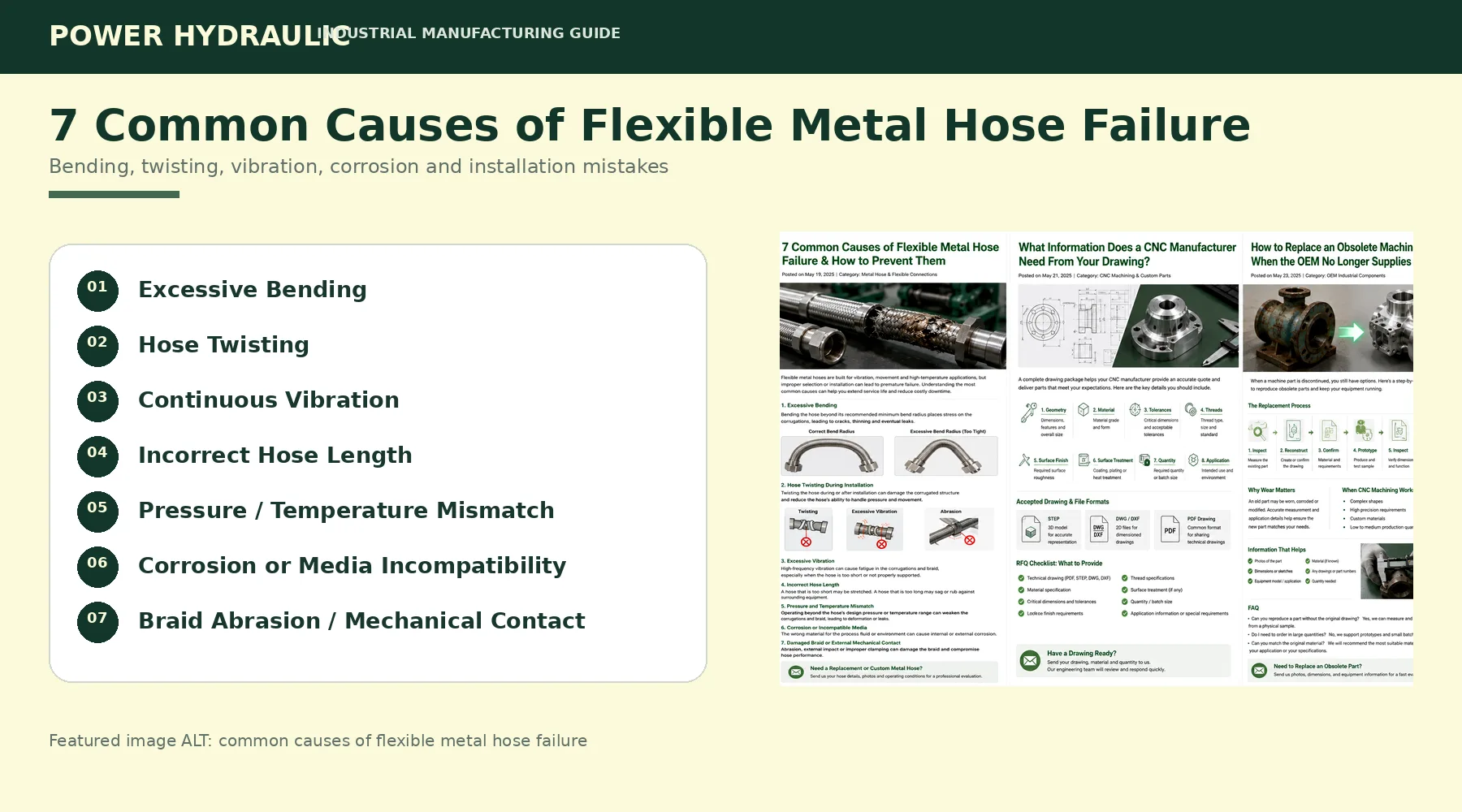
First: Forced torsion during installation
Metal hose can bear bending and tensile displacement, but cannot resist torsion. On construction sites, workers often force-rotate the hose to align flange holes, leaving hidden torsion stress. After several months of operation, stress concentration causes corrugation cracking and leakage.
Second: Exceeding minimum bending radius
Too small a bending radius leads to excessive local deformation of corrugations, uneven pressure bearing, and early fatigue damage. Our factory provides unified minimum bending radius data for each specification and marks it in official technical drawings to guide client installation.
Third: External friction and impact damage
On complex industrial sites, hose assemblies easily rub against steel structures or suffer frequent impact, causing braid wire breakage and outer layer damage, further leading to pressure resistance failure.
7.2 Standard Maintenance & Inspection Guidelines
For overseas industrial clients with annual maintenance plans, we provide systematic inspection suggestions:
1. Visual inspection every month: check braid breakage, surface corrosion, and fitting weld cracks
2. Pressure tightness inspection every quarter: focus on the transition zone and crimping position
3. Regular cleaning of surface dust and corrosive attachments to avoid long-term chemical erosion
4. For dynamic vibrating pipelines, regularly check fixing clamps to prevent swing overload
7 Common Causes of Stainless Steel Metal Hose Failure & Preventive Methods
Step-by-Step Metal Hose Installation Guide to Avoid Leakage
Regular Inspection & Maintenance Checklist for Industrial Metal Hoses
8. International Standards, Factory Testing & Export Quality Control
As a long-term export-oriented metal hose manufacturer, all our products are produced and tested in accordance with international industrial specifications, covering CE, ISO, and ASME-related standards. We completely understand global buyers’ concerns about cross-border product consistency and compliance.
8.1 Full-Scale Factory Testing Process
Unlike small workshops that only conduct random sampling, our factory implements 100% full inspection for all export hose assemblies:
1. Raw material spectrum analysis: verify 304/316L alloy composition to prevent unqualified material mixing
2. Hydraulic pressure test: 1.5 times rated working pressure, no leakage and no deformation for 5 minutes
3. Airtightness test: zero bubble detection for gas medium projects
4. Bending fatigue sampling test: simulate long-term dynamic working conditions
5. Finished product dimension inspection: strictly control assembly length, flange verticality, and thread precision
8.2 Export Packaging & Shipment Standard
Many exported metal hoses are damaged by extrusion and deformation during ocean transportation. We have formulated exclusive export packaging standards: independent pearl cotton wrapping, rigid carton reinforcement, and wooden box customization for super-long and large-diameter products, effectively avoiding freight damage and ensuring zero-defect delivery to overseas ports.
Main International Standards for Industrial Metal Hoses: CE, ISO, ASME
Quality Control Tests for Metal Hoses Before Export Shipment
Safe Packaging Solutions for Metal Hoses During Ocean Shipping
9. Our Custom Manufacturing Strength & OEM/ODM Service Advantages
What distinguishes professional metal hose factories from ordinary trading companies is independent engineering customisation capability and stable batch production quality. We have accumulated rich manufacturing experience in non-standard custom projects for global industrial clients.
9.1 Customisable Capability Coverage
– Non-standard diameter, ultra-long assembly, special bending size customisation
– Multi-standard end fittings: ANSI, DIN, JIS, BS and custom welded joints
– Special medium adaptation: high temperature, low temperature, strong corrosion, anti-static, explosion-proof requirements
– Special environment adaptation: marine salt spray, coastal corrosion, outdoor ultraviolet aging resistance
9.2 Factory Production Advantages
We own full-process production equipment from tube forming, braiding, welding, crimping to finished product testing. All core processes are independently completed in the factory, which effectively controls product quality stability and delivery cycle. For bulk export orders, we support flexible MOQ and stable monthly output to meet long-term agent distribution and EPC project procurement demands.
Our engineering team can provide one-stop technical services: parameter confirmation, solution optimisation, drawing design, sample confirmation, batch production and after-sales technical guidance, helping global buyers avoid specification errors and project risks.
Custom OEM & ODM Metal Hose Solutions for Industrial Projects
MOQ & Lead Time for Bulk Metal Hose Orders From Chinese Factory
Our Metal Hose Assembly Manufacturing Process: From Raw Material to Finished Product
10. Conclusion
Industrial metal hose selection is never a simple purchase of standard parts. It requires systematic judgment combining medium characteristics, working pressure, temperature, installation environment, and dynamic operating conditions. Most on-site failures and cost losses stem from superficial parameter matching and ignoring actual working condition differences.
As a professional export-focused metal hose manufacturer with decade-long project experience, we do not only provide standard products. More importantly, we deliver targeted engineering solutions based on real project cases and field feedback. Whether you need standard bulk procurement or complex non-standard customised assemblies for special industrial projects, our technical team can provide accurate, safe, and cost-effective metal hose solutions.
CTA
If you are looking for a reliable, technically experienced metal hose supplier from China, send us your working parameters, medium requirements, installation environment, or technical drawings. Our professional engineering team will evaluate your project, avoid selection risks, and provide a customised quotation and technical solution within 24 hours.