
8 Flexible Metal Hose Installation Mistakes That Can Shorten Service Life
Flexible metal hose assemblies are widely used in industrial systems to absorb vibration, compensate for thermal expansion, accommodate equipment movement, and provide flexible connections between rigid piping components.
Compared with traditional rigid piping, a flexible metal hose can improve system reliability by reducing stress caused by movement and vibration.
However, the performance and service life of a metal hose assembly depend not only on the hose design itself but also on the installation method.
Even a high-quality corrugated stainless steel hose can experience premature failure when installers apply excessive bending force, introduce torsion, select an incorrect installation length, or ignore external mechanical contact.
For industrial engineers, maintenance teams, and purchasing specialists, correct installation is one of the most important factors affecting the reliability of flexible metal hose assemblies.
This guide explains the most common installation mistakes and provides practical recommendations for improving hose performance.
Why Installation Matters for Flexible Metal Hose
A flexible metal hose is designed to accommodate specific types of movement.
Typical applications include:
- Vibration isolation between equipment and piping
- Thermal expansion compensation
- Flexible connections for pumps and compressors
- Movement absorption in industrial machinery
- Connection solutions where rigid piping installation is difficult
However, a metal hose is not designed to solve every piping alignment problem.
Incorrect installation can introduce additional stress into the hose structure.
Common installation-related problems include:
- Twisting during tightening
- Excessive bending
- Incorrect hose length
- Misaligned connections
- External abrasion
- Unsupported weight
- Improper movement direction
Many metal hose failures are not caused by the hose material itself but by installation conditions.
For this reason, engineers should evaluate the complete application before replacing or installing a new hose assembly.
1. Do Not Twist the Hose During Installation
One of the most common installation mistakes is introducing torsion into the flexible metal hose.
A metal hose is designed primarily for bending and controlled movement.
It should not be rotated around its axis.
Twisting can occur when installers tighten threaded connections without controlling the hose orientation.
For example:
- One end of the hose is fixed
- The opposite fitting is rotated during installation
- The hose body absorbs the rotational movement
This creates torsional stress inside the corrugated hose and stainless steel braid.
Over time, repeated twisting can accelerate metal fatigue and reduce service life.
Why Threaded Connections Can Introduce Torsion
Threaded fittings require rotational tightening.
If the hose assembly does not include proper installation methods, the tightening force can transfer directly into the flexible section.
The result may include:
- Twisted corrugations
- Uneven stress distribution
- Reduced flexibility
- Premature fatigue
How to Check Hose Orientation
Before final tightening:
- Confirm that the hose follows its natural installation direction
- Make sure the hose is not rotated
- Check that the braid pattern remains uniform
- Verify that fittings are aligned correctly
If the hose appears twisted before operation, correct the installation before applying pressure.
2. Avoid Excessively Tight Bends
Flexible metal hoses can bend, but they still require an appropriate bending radius.
Forcing a hose into an extremely tight curve creates concentrated stress in the corrugated section.
Repeated movement in the same small area may accelerate fatigue.
A common mistake is creating a sharp bend immediately beside the end fitting.
The hose should have enough length to distribute movement smoothly.
Why Bend Geometry Matters
The bending shape affects how stress is distributed.
A smooth curve allows the corrugated hose to flex gradually.
A sharp bend concentrates stress in a limited area.
Incorrect bending may lead to:
- Corrugation deformation
- Braid stress
- Reduced flexibility
- Shortened service life
Keep Bends Away From End Fittings
The connection area between the hose and fitting is usually more rigid than the flexible hose body.
Allowing movement directly beside the fitting can create a high-stress area.
A better installation approach is to allow the flexible section to absorb movement instead of forcing the fitting area to flex.
3. Do Not Use the Hose to Correct Severe Misalignment
A flexible metal hose can accommodate limited installation challenges, but it should not replace proper piping alignment.
A common misunderstanding is:
“The hose is flexible, so it can fix any alignment problem.”
This approach can create continuous stress.
Before installation:
- Align connection points correctly
- Confirm pipe positioning
- Check flange or thread alignment
- Avoid forcing the hose into position
The hose should operate in a relaxed condition rather than under constant mechanical load.
4. Choose an Appropriate Assembly Length
The correct hose length is critical for reliable operation.
A hose that is too short may experience:
- Excessive tension
- Limited movement capability
- Increased stress near connections
A hose that is too long may cause:
- Uncontrolled bending
- Sagging
- External contact
- Additional vibration
When selecting hose length, consider:
- Connection distance
- Movement requirements
- Installation space
- Equipment vibration
- Thermal expansion
For replacement projects, photographs of the original installation are often valuable.
They show how the hose was positioned during operation.

5. Understand the Direction of Movement
Flexible metal hoses can handle different types of movement.
Understanding the movement direction helps determine the correct installation method.
Lateral Movement
Lateral movement occurs when two connection points move sideways relative to each other.
The hose routing should allow the flexible section to absorb this movement without excessive bending.
Angular Movement
Angular movement occurs when the connection points rotate relative to each other.
The hose should have sufficient flexibility and appropriate length to accommodate this movement.
Vibration
Many flexible metal hoses are installed near:
- Pumps
- Compressors
- Motors
- Hydraulic equipment
The hose can help reduce vibration transmission.
However, excessive vibration combined with poor installation may accelerate fatigue.
Important factors include:
- Hose length
- Support conditions
- Movement frequency
- Installation direction
6. Prevent Braid Abrasion and External Contact
The stainless steel braid provides important mechanical support for many metal hose assemblies.
However, continuous external contact can damage braid wires.
Avoid allowing the hose to rub against:
- Machine frames
- Sharp edges
- Nearby piping
- Supports
- Moving components
Abrasion may gradually weaken the braid structure.
Installation Inspection Points
Check:
- Is there enough clearance around the hose?
- Can the hose move freely?
- Does the braid contact surrounding objects?
- Are there sharp edges nearby?
- Could vibration create repeated rubbing?
A small clearance issue during installation may become a serious problem after thousands of operating cycles.

7. Check End Connection Alignment Before Tightening
Correct connection alignment helps prevent unnecessary stress.
Before tightening:
- Confirm flange positioning
- Check thread alignment
- Avoid forcing connections together
- Verify that the hose is not carrying pipe weight
A metal hose should connect naturally between two points.
It should not be installed under tension.
8. Review the Installation After Startup
Installation inspection should continue after the system begins operation.
During initial operation, check:
- Unexpected movement
- Excessive vibration
- Contact with surrounding components
- Leakage
- Abnormal deformation
Early inspection can identify problems before they become major failures.
Flexible Metal Hose Pre-Installation Checklist
Before installing a metal hose assembly, confirm the following:
Application Information
- Operating medium
- Temperature conditions
- Pressure requirements
- Movement type
Installation Information
- Correct hose length
- Connection alignment
- Bend direction
- Clearance around hose
Mechanical Check
- No twisting
- No excessive bending
- No external abrasion
- No unnecessary tension
A careful installation process can significantly improve hose reliability.
When Should You Replace an Existing Metal Hose?
A flexible metal hose should be evaluated when you notice:
- Leakage
- Damaged braid
- Visible deformation
- Reduced flexibility
- Corrosion
- Repeated failure after replacement
However, simply replacing the hose may not solve the original problem.
Before ordering a replacement, review:
- Installation condition
- Operating environment
- Movement requirements
- Connection details
- Failure location
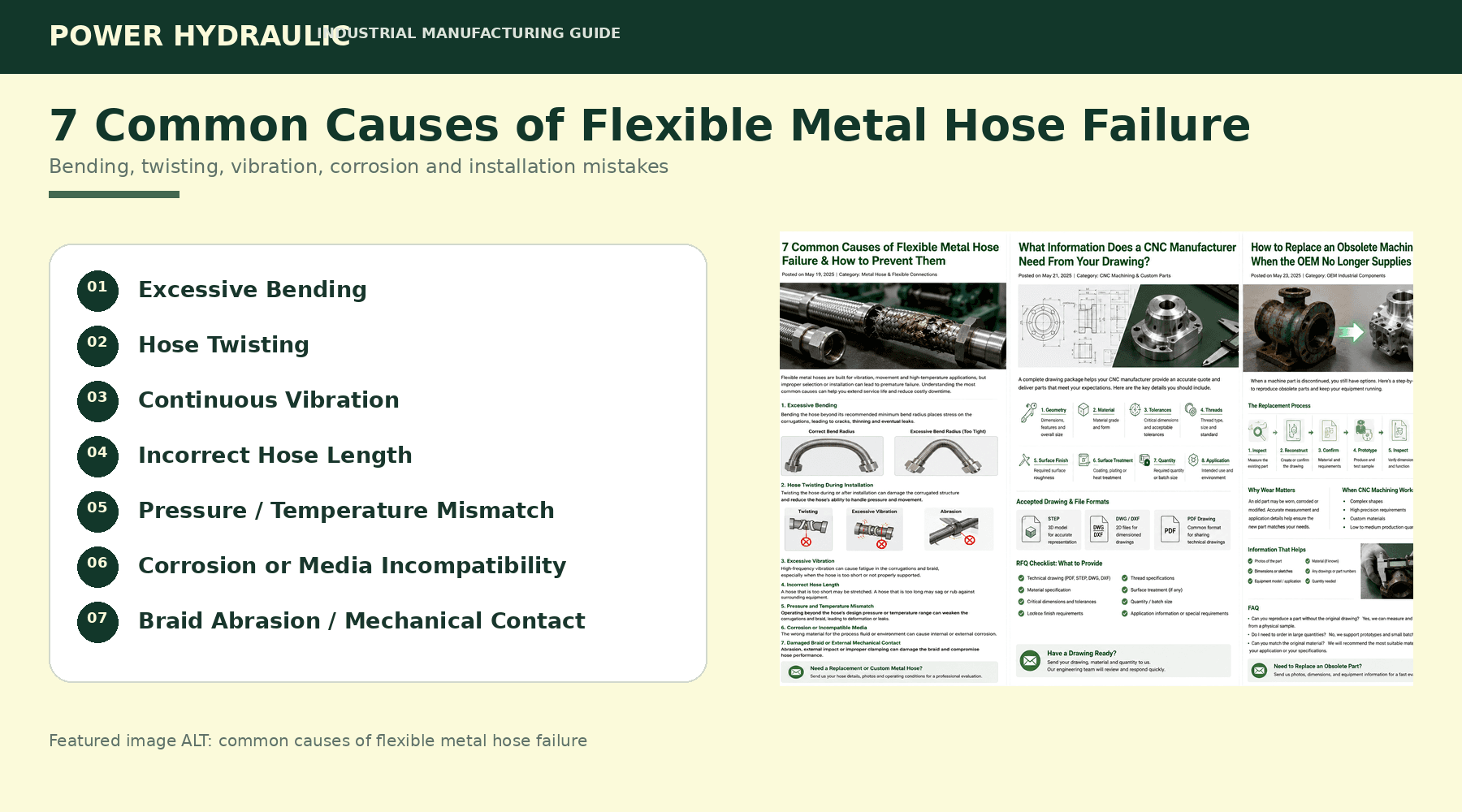
Our previous article explains the common causes of flexible metal hose failure and how to identify the root problem.
How to Select a Replacement Flexible Metal Hose
When requesting a replacement metal hose assembly, provide:
- Hose diameter
- Overall length
- End connection type
- Installation photos
- Operating temperature
- Working pressure
- Process medium
- Movement requirements
For applications without original drawings, an existing sample can also provide useful information for evaluation.
Related service:
- Custom Parts From Drawing
- OEM Industrial Components
FAQ
Can a flexible metal hose be twisted during installation?
No. Flexible metal hoses are designed for controlled bending and movement. Twisting introduces torsional stress and may reduce service life.
Why should a metal hose not bend directly beside the fitting?
The fitting area is more rigid than the flexible section. Bending near the fitting concentrates stress and may accelerate fatigue.
Can flexible metal hose correct pipe misalignment?
A metal hose can accommodate limited movement, but it should not replace proper piping alignment.
How do I determine the correct metal hose length?
Consider connection distance, movement requirements, installation space,ce and operating conditions. The hose should not be installed under tension.
Why does a metal hose repeatedly fail after replacement?
Repeated failure may indicate an installation issue, incorrect movement direction, excessive vibration, unsuitable routing, or incorrect hose selection.
Need a Custom Metal Hose Assembly?
Power Hydraulic provides custom metal hose assembly solutions based on customer requirements.
Send us:
- Hose dimensions
- Connection details
- Installation photos
- Application information
- Existing samples, if available
Our engineering team can review your requirements and help develop a suitable flexible connection solution.