7 Common Causes of Flexible Metal Hose Failure & How to Prevent Them
Flexible metal hose assemblies help industrial systems accommodate vibration, movement, thermal expansion, and difficult piping layouts. Their corrugated metallic construction provides flexibility, while stainless steel braid can provide additional mechanical support in suitable applications.
However, even a properly manufactured flexible metal hose can fail prematurely when installation or operating conditions do not match the hose’s design.
For maintenance teams and industrial buyers, simply replacing a damaged hose with another identical-looking assembly may not solve the problem.
The first step should be identifying what can cause the metal hose failure.
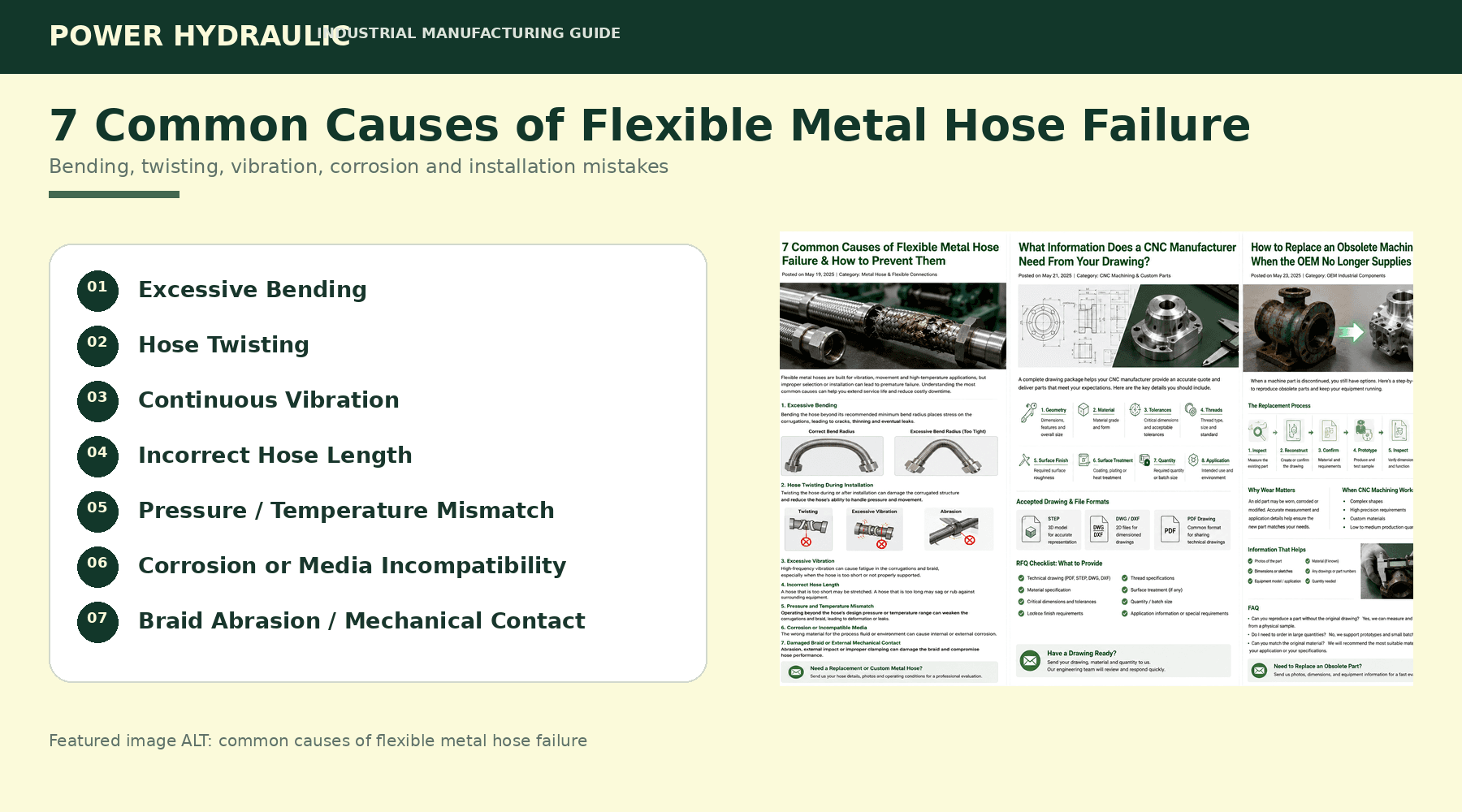
Common causes include excessive bending, hose twisting, vibration, incorrect hose length, unsuitable operating conditions, corrosion, and external mechanical damage.
Understanding these factors can help reduce repeated failures and provide better information when ordering a replacement hose.
Why Flexible Metal Hose Failure Requires More Than a Visual Check
The location of the damage does not always reveal the original cause.
For example, a leak near an end fitting may appear to indicate a connection problem.
In reality, repeated bending directly beside the fitting may have concentrated stress in the same area for thousands of operating cycles.
Likewise, damage to stainless steel braid may result from continuous contact with nearby machinery rather than from an internal hose problem.
Before replacing a failed metal hose, review the complete installation.
Important questions include:
- Where does the hose bend?
- Does the equipment vibrate?
- Does the hose twist during installation?
- Does the hose touch nearby equipment?
- Is the installed hose length appropriate?
- What medium flows through the hose?
- What temperatures does the assembly experience?
- What is the operating pressure?
The answers can help identify whether the problem comes from the hose itself or from the application.
1. Excessive Bending
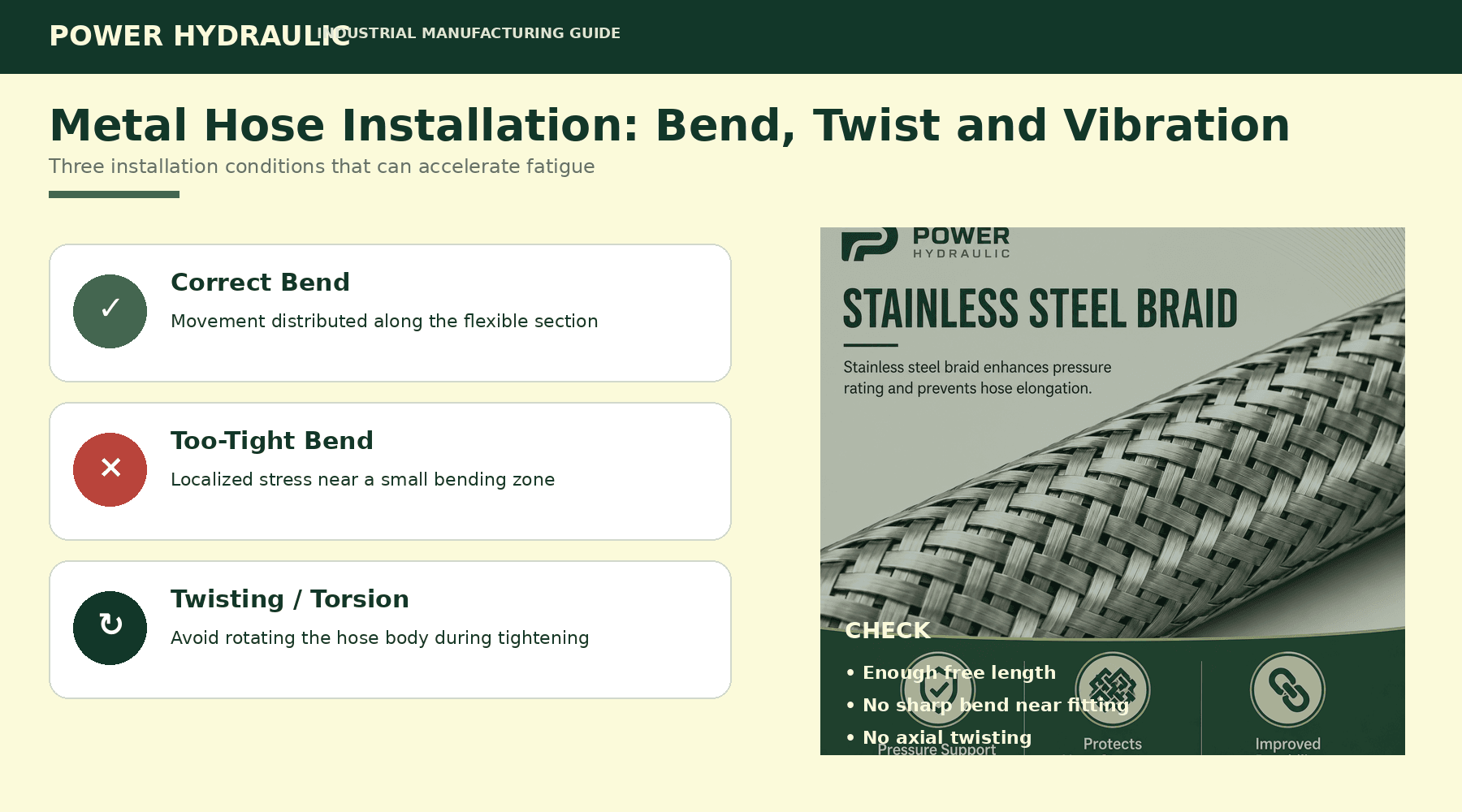
Corrugated metal hose provides flexibility, but it still requires enough space to form an appropriate curve.
When installers force a hose into a tight bend, the corrugations experience concentrated stress.
Repeated movement in this small area can accelerate fatigue.
The risk may increase when the bend begins directly beside the end fitting.
How to Reduce Excessive Bending
Provide enough flexible length for the expected movement.
Avoid forcing the hose into a sharp curve simply because installation space is limited.
Whenever possible, keep the main bending section away from the hose end connection.
If the existing piping configuration cannot provide enough space, changing the routing may offer a better solution than forcing the hose into position.
2. Hose Twisting During Installation
Flexible metal hose generally works best when it bends in the intended direction instead of twisting around its axis.
Twisting often occurs during installation of threaded fittings.
For example, an installer may rotate one fitting while the opposite end remains fixed.
This action can transfer torsional stress into the flexible hose body.
Repeated torsional loading may reduce service life.
How to Avoid Twisting
Keep the hose in its natural orientation during installation.
Use appropriate installation methods so that tightening the fitting does not rotate the flexible section.
After installation, visually inspect the hose and braid to confirm that they remain aligned.
3. Excessive or Continuous Vibration
Pumps, compressors, motors,s and rotating machinery can transmit vibration into connected pipework.
Flexible metal hose can help accommodate vibration, but the hose still needs the correct length and installation geometry.
Severe or concentrated vibration may contribute to fatigue.
Important factors include:
- Hose length
- Movement direction
- Installation geometry
- Frequency of movement
- Bend location
- Distance between the bend and end fitting
A hose that is too short or installed under continuous tension may react poorly to vibration.
What to Check
If the same hose repeatedly fails, review whether:
- The assembly has enough flexible length
- The hose bends rather than twists
- Movement concentrates in one small area
- Brackets or adjacent piping create additional stress
- The hose contacts surrounding equipment
Replacing the hose alone may not solve an installation-related problem.
4. Incorrect Hose Length
A hose that is too short may remain under tension after installation.
A hose that is too long may sag, rub against nearby equipment, or create unnecessary bends.
The correct hose length depends on more than the straight-line distance between the connection points.
Consider:
- Equipment movement
- Vibration
- Bend geometry
- Connection orientation
- Available installation space
When replacing an existing assembly, take photographs before removing the old hose.
The installed position may reveal important information that the loose hose cannot show.
5. Pressure and Temperature Mismatch
One common specification mistake is providing only one operating parameter.
For example:
“We need a high-temperature metal hose.”
Temperature alone does not define the correct hose.
Pressure, temperature, hose diameter, medium, movement,t and material all need consideration.
When requesting a new or replacement metal hose assembly, provide:
- Normal operating temperature
- Maximum expected temperature
- Working pressure
- Process medium
- Hose diameter
- Overall assembly length
- End connection type
- Movement or vibration information
This allows the manufacturer to evaluate the complete operating condition.
6. Corrosion or Incompatible Media
Stainless steel provides useful corrosion resistance, but no single stainless steel grade suits every operating environment.
Corrosion may affect:
- Corrugated hose
- Stainless steel braid
- Weld areas
- End fittings
The external environment also matters.
A hose may carry a relatively mild process medium while operating in a corrosive surrounding environment.
When ordering a replacement assembly, provide information about both the internal medium and external conditions.
Do not choose the replacement material based only on visual similarity.
7. Mechanical Abrasion and Braid Damage
The stainless steel braid should not continuously rub against:
- Machine frames
- Sharp edges
- Adjacent piping
- Brackets
- Moving equipment
Repeated contact can damage braid wires.
Once braid damage occurs, the assembly may lose part of its mechanical support.
A replacement hose should have enough clearance to move without rubbing against surrounding components.
Common Warning Signs of Flexible Metal Hose Failure
| Symptom | Possible Cause | What to Check |
|---|---|---|
| Leak near fitting | repeated bending or installation stress | bend location and fitting area |
| Local deformation | excessive bending | hose routing |
| Damaged braid | abrasion | nearby equipment |
| Twisted hose | installation torsion | fitting orientation |
| Repeated early failure | application mismatch | pressure, temperature, length and movement |
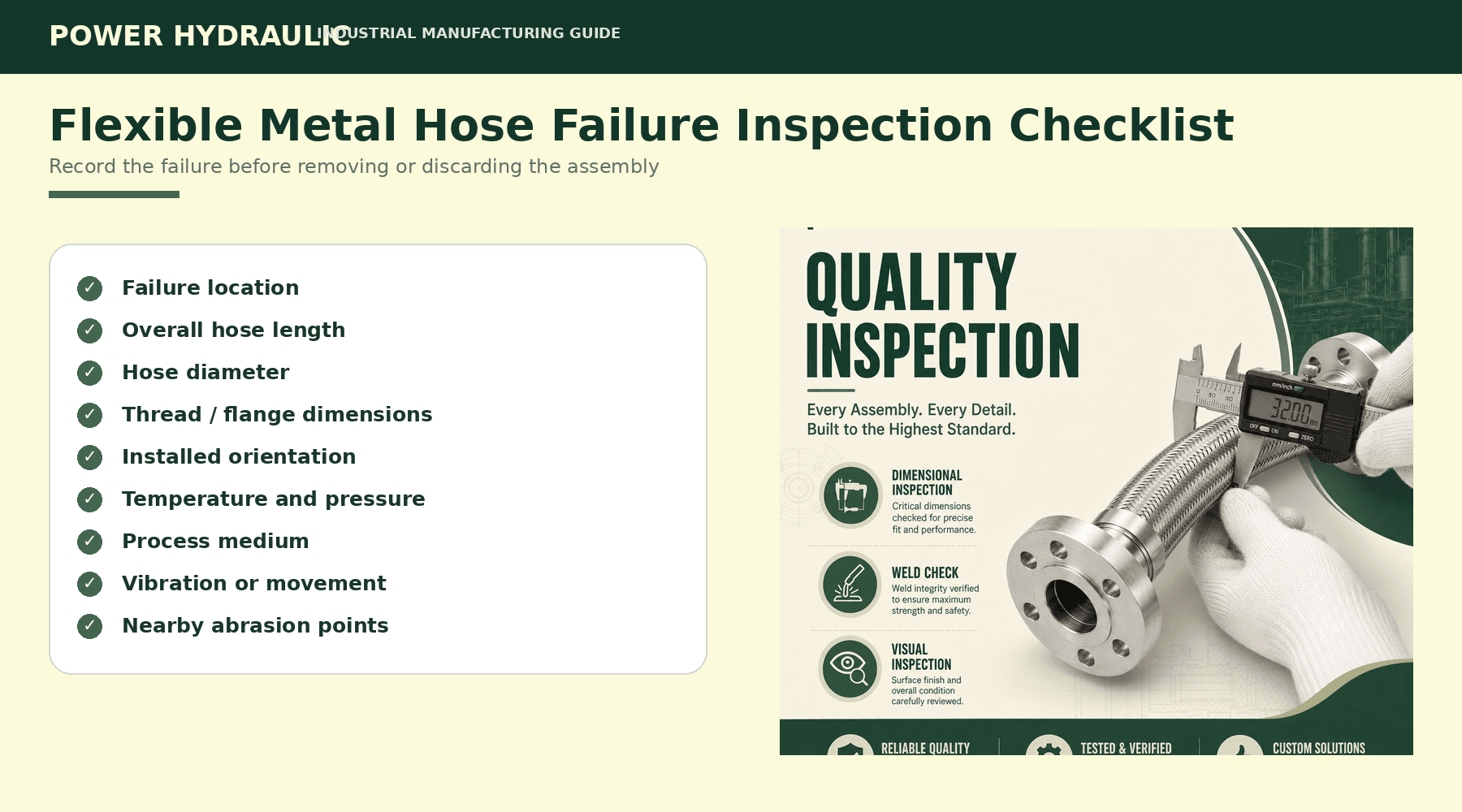
What Information Should You Record Before Replacing the Hose?
Before disposing of the damaged assembly, collect as much information as possible:
- Hose diameter
- Overall length
- End connection type
- Thread specification
- Flange dimensions
- Failure location
- Installation photographs
- Temperature
- Pressure
- Process medium
- Movement conditions
If the original drawing is unavailable, the damaged hose may still provide useful information.
However, deformation or wear may have changed its original geometry.
Can a Replacement Metal Hose Be Manufactured From a Sample?
Yes.
An existing assembly can help identify:
- Hose size
- Braid configuration
- Length
- Thread type
- Flange dimensions
- End fitting geometry
For a better replacement evaluation, also provide the actual operating conditions.
The sample shows the physical product.
The application tells the manufacturer what the replacement needs to do.
FAQ
Why does a flexible metal hose leak near the fitting?
Repeated bending, twisting, vibration, or installation stress may concentrate near the hose end connection.
Can excessive bending damage a corrugated metal hose?
Yes. Tight bending can increase localized stress on the corrugations.
Can vibration cause flexible metal hose failure?
Continuous vibration may contribute to fatigue when the assembly length or installation geometry does not suit the movement.
What causes stainless steel braid damage?
Abrasion, nearby equipment contact, poor routing,g and uncontrolled movement are common causes.
Can a metal hose be reproduced from an existing sample?
Yes. A sample can provide useful dimensional and connection information when the original drawing is unavailable.
Need to Replace a Failed Metal Hose?
Send us your:
Photos · Hose Dimensions · End Connections · Temperature · Pressure · Medium · Existing Sample
Power Hydraulic can review the available technical information for your replacement metal hose project.