
Replacement Part Drawings: How to Control Revisions Before Repeat Production
When companies replace obsolete or unavailable industrial components, the first production order often requires engineering review, sample evaluation, and prototype adjustments.
A replacement part may start from:
- an existing physical sample
- an outdated drawing
- a damaged component
- incomplete technical information
- a modified machine part
During this process, engineers may discover important improvements or corrections.
However, one common problem appears during repeat production:
The first part works correctly, but the next order is manufactured according to an outdated version.
This is why a controlled replacement part drawing is important.
A clear drawing revision system helps manufacturers and buyers maintain consistency between:
- prototype approval
- first production
- repeat orders
- future replacements
This article explains why drawing revision control matters and how industrial buyers can reduce mistakes during custom replacement part manufacturing.
Why Replacement Parts Often Change During Development
Unlike standard catalog products, replacement components often involve existing equipment with limited information.
During the evaluation process, manufacturers may discover:
- missing dimensions
- unclear interfaces
- worn surfaces
- incorrect assumptions from old drawings
- differences between the original design and actual installation
For example, a physical sample may show the external shape of a component, but further inspection may reveal that certain:
- mounting dimensions
- sealing areas
- connection points
- mating surfaces
require additional confirmation.
These findings may lead to drawing updates before repeat production.
The goal of revision control is not simply recording changes.
The goal is ensuring that everyone works from the same approved manufacturing information.
Why a Physical Sample Should Not Remain the Only Reference
A physical sample is often valuable when original documentation is unavailable.
It can help manufacturers understand:
- overall geometry
- connection design
- assembly relationship
- approximate dimensions
However, a physical sample alone may not always provide complete manufacturing information.
An old component may contain:
- wear from operation
- previous modifications
- deformation
- repair marks
- unknown design changes
For long-term production, the sample should usually be converted into clearer technical information, such as:
- CAD model
- manufacturing drawing
- approved specifications
This creates a more reliable reference for future orders.
What Should Become the Controlled Manufacturing Reference?
After evaluation and approval, buyers and manufacturers should clearly define the latest production reference.
Important information may include:
Part Identification
A clear part number or identification method helps prevent confusion between similar components.
Drawing Revision
A revision identifier shows which version should be used for manufacturing.
Examples:
- Rev A
- Rev B
- Rev C
The specific naming system can vary, but the purpose is the same:
Everyone should know which version is current.
Critical Dimensions
Not every dimension has the same importance.
The drawing should clearly identify features related to:
- installation fit
- mating components
- sealing areas
- functional interfaces
Material Requirements
The approved material information should be clearly recorded when required.
This helps prevent differences between production batches.
Surface Requirements
Where surface condition affects function, the requirement should be clearly documented.
Examples may include:
- sealing surfaces
- contact areas
- sliding interfaces
Why Verbal or Email-Only Changes Create Risk
During custom manufacturing projects, changes are often discussed through:
- emails
- phone conversations
- meeting notes
These communications can be useful during development.
However, if an approved change is not transferred into the official drawing or specification, problems may appear later.
For example:
A customer requests:
“Please make this hole slightly larger.”
If this change only exists in an email conversation, future production may return to the previous version.
Updating the controlled drawing helps ensure:
- engineering teams use the same information
- manufacturers follow the latest requirement
- repeat orders remain consistent
What Should Happen After First Article Inspection?
The first production part provides an opportunity to confirm the manufacturing result.
A typical process includes:
Step 1: Manufacture the First Part
The manufacturer produces the initial component based on the current drawing or available reference information.
Step 2: Review Fit and Function
The buyer evaluates important factors such as:
- installation fit
- connection compatibility
- critical dimensions
- functional requirements
Step 3: Record Approved Changes
If adjustments are required, they should be reflected in:
- updated drawing
- revised CAD model
- confirmed specifications
Step 4: Release the Updated Version
The approved revision becomes the reference for future production.
This creates a clear transition from prototype development to repeat manufacturing.
How to Record a Drawing Revision Clearly
A useful revision record should answer three questions:
What Changed?
Examples:
- dimension adjustment
- geometry modification
- material update
- interface correction
Why Was It Changed?
Possible reasons:
- improved fit
- installation requirement
- prototype feedback
- manufacturing improvement
Which Version Should Be Used?
The latest approved revision should clearly replace previous versions.
This prevents multiple drawings from circulating between different teams.
What If the Buyer and Manufacturer Have Different Drawing Versions?
This situation can create unnecessary confusion.
Before placing a repeat order, confirm:
- drawing revision
- CAD version
- part number
- material requirement
- approved modifications
Both parties should verify that they are referring to the same manufacturing information.
A simple revision confirmation before production can prevent larger issues later.
Managing Replacement Parts That Started From a Physical Sample
Many industrial replacement projects begin without complete documentation.
A common development path is:
Physical Sample
↓
Measurement and Evaluation
↓
CAD Reconstruction
↓
Prototype Production
↓
Drawing Approval
↓
Repeat Manufacturing
This process helps transform an unknown replacement component into a controlled manufacturing item.
Related:
Manufacturing a Part From a Physical Sample
Drawing Control for Small-Batch and Repeat Production
Small-batch manufacturing does not remove the need for drawing control.
Even when quantities are limited, clear documentation helps maintain consistency.
For replacement components, future orders may occur months or years later.
Without a controlled drawing, companies may need to repeat:
- measurement
- engineering review
- prototype adjustment
A stable drawing reference improves efficiency for future production.
What Buyers Should Confirm Before Reordering a Replacement Part
Before placing a repeat order, check:
✓ Correct part number
✓ Latest drawing revision
✓ Approved CAD file
✓ Material information
✓ Critical dimensions
✓ Previous prototype changes
✓ Quantity requirement
✓ Application information
A short review before ordering can prevent production based on outdated information.
Custom Replacement Components From Power Hydraulic
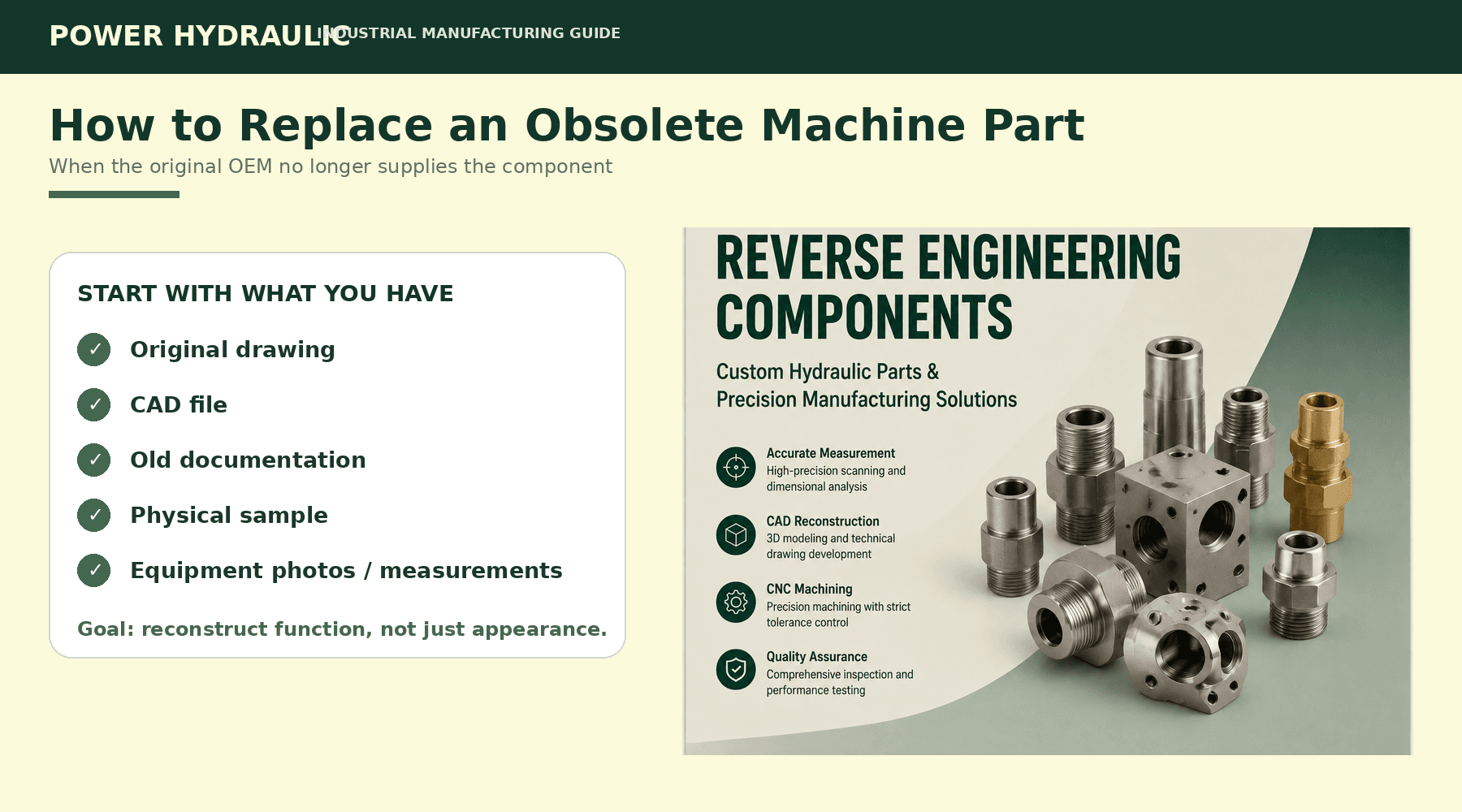
Power Hydraulic provides customized manufacturing solutions for industrial replacement components.
Customers can provide:
- Existing samples
- Engineering drawings
- CAD files
- Product photos
- Application information
Our engineering team can evaluate available information and support the development of customized industrial components.
Related solutions:
FAQ
What is a replacement part drawing?
A replacement part drawing is a technical document that defines the approved manufacturing requirements for producing a replacement component.
Why is drawing revision control important?
Revision control helps ensure manufacturers and customers use the same approved information during repeat production.
Can a physical sample replace a manufacturing drawing?
A physical sample can provide valuable reference information, but a controlled drawing usually provides clearer requirements for repeat manufacturing.
What should be updated after a prototype modification?
Approved changes should be reflected in the latest drawing, CAD model, or manufacturing specification.
Why do repeat orders sometimes produce different parts?
Different results may occur when teams use different drawing versions, incomplete specifications, or outdated information.
Do small-batch replacement parts need drawing control?
Yes. Clear documentation helps maintain consistency even when production quantities are limited.
What information should buyers confirm before reordering?
Confirm the latest drawing revision, part identification, material information, critical dimensions, and approved changes.
CTA
Need a Replacement Part Manufactured From Existing Information?
Send your available drawing, CAD file, physical sample photos, or component details.
Power Hydraulic can help evaluate the manufacturing requirements for customized replacement components and OEM industrial parts.