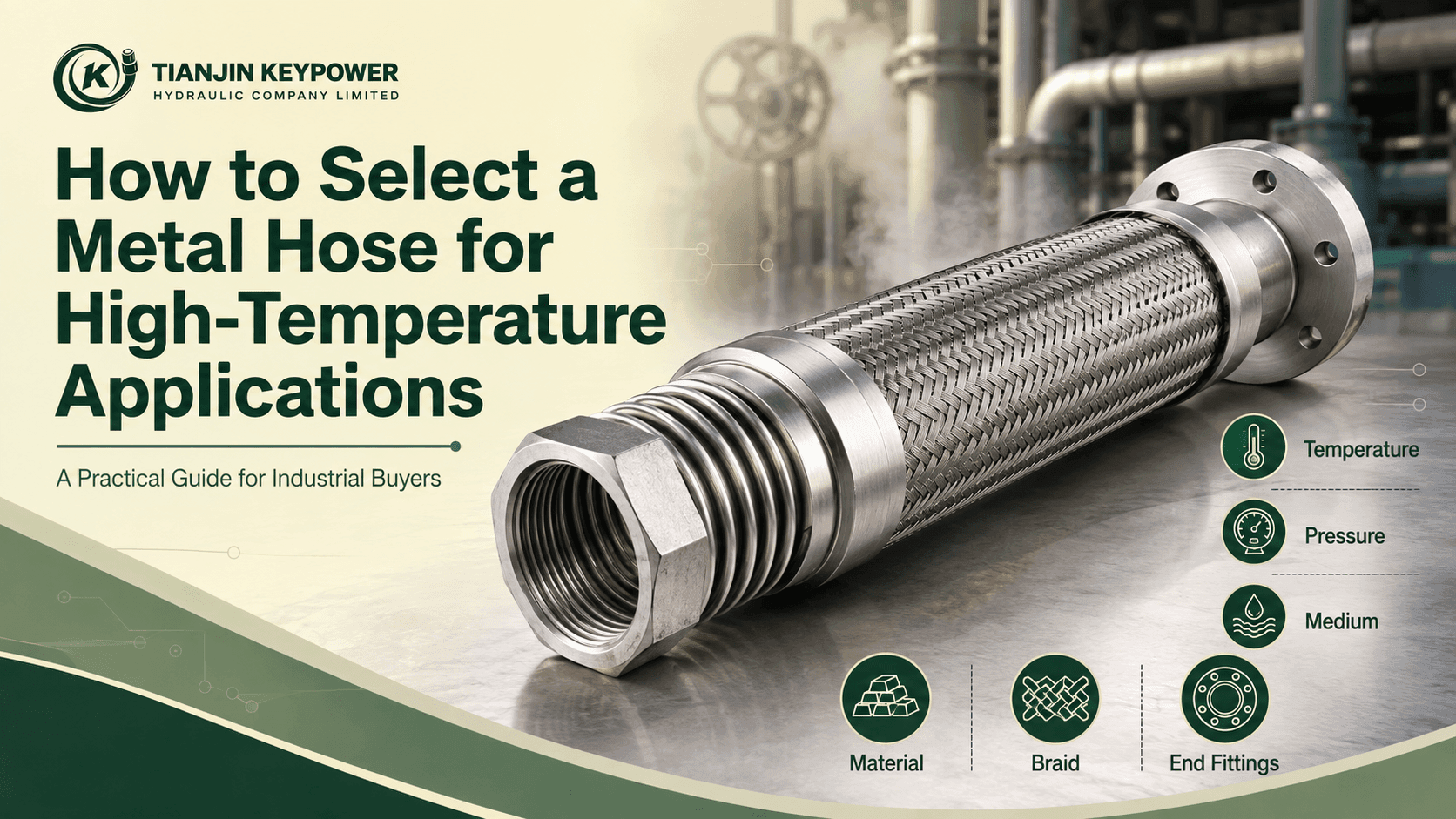
How to Select a Metal Hose for High-Temperature Applications
Selecting a metal hose for a high-temperature system requires more than finding a hose that “handles heat.”
Temperature interacts with pressure, material, process medium, movement, and installation conditions.
A hose that works correctly in one high-temperature system may not suit another even if both operate at a similar nominal temperature.
For industrial buyers and engineers, the safest approach is to evaluate the entire application.
1. Start With Actual Operating Temperature
The first question should be:
What temperature does the hose actually experience during operation?
Do not provide only the normal ambient temperature.
Consider:
- Continuous operating temperature
- Temporary temperature peaks
- Startup conditions
- Shutdown conditions
- External radiant heat
- Process medium temperature
Temperature affects material behavior and can also influence pressure capability.
This is why manufacturers need both temperature and pressure information.
2. Confirm Working Pressure
Temperature and pressure should never be evaluated independently.
Provide:
- Normal working pressure
- Expected pressure fluctuations
- Vacuum conditions if applicable
- Relevant operating cycle information
Do not select a hose based on a generic pressure number without considering temperature.
3. Identify the Process Medium
What flows through the hose?
Examples may include:
- Steam
- Gas
- Air
- Water
- Oil
- Process fluids
- Exhaust gases
- Chemical media
The medium influences material compatibility.
A metal hose suitable for one fluid may not suit another environment.
4. Select the Appropriate Material
Stainless steel is widely used in high-temperature flexible metal hoses.
Common project specifications may consider grades such as:
- 304
- 304L
- 316
- 316L
The final choice depends on corrosion conditions, medium compatibility, temperature,e and customer requirements.
316-series materials may provide additional corrosion resistance in suitable environments, but they are not automatically necessary for every project.
5. Determine Whether the Hose Needs Braid
The stainless steel braid supports the corrugated hose under pressure.
Depending on the system, engineers may specify:
- Unbraided hose
- Single braid
- Multiple braid configuration
The correct option depends on hose diameter, working pressure, re and movement requirements.
6. Understand the Required Movement
A flexible hose can accommodate movement, but different movement patterns create different stresses.
Consider:
- Lateral movement
- Angular movement
- Vibration
- Repeated flexing
- Thermal expansion
Do not simply install a metal hose wherever movement exists.
The hose length and installation geometry need to match the intended motion.
7. Check Bend Radius
One of the most common metal hose mistakes is forcing the hose into a bend that is too tight.
Excessive bending can increase stress on the corrugations.
The installation should therefore provide enough space for the hose to bend naturally.
Avoid sharp bends directly next to the end fitting.
8. Consider Thermal Expansion
High-temperature piping expands as it heats.
If the system cannot accommodate this expansion, additional stress may transfer to:
- Flanges
- Valves
- Pumps
- Pipework
- Equipment ports
A flexible hose can help accommodate certain movement patterns.
However:
A flexible metal hose should not automatically be treated as a substitute for a properly engineered expansion joint.
The expected movement needs to be known.
9. Evaluate Vibration
High-temperature systems often also include pumps, compressors, engines, or rotating machinery.
This means the hose may need to handle both temperature and vibration.
Important questions include:
- What causes the vibration?
- How large is the movement?
- Is the vibration continuous?
- In which direction does the equipment move?
This information can influence hose length and installation.
10. Select the Correct End Connections
High-temperature hoses connect to many types of equipment.
Possible connections include:
- Flanges
- Male threads
- Female threads
- Weld ends
- Tube connections
- Custom fittings
For OEM machinery, standard catalog fittings may not match the equipment.
Custom CNC-machined fittings provide another option.
11. Avoid Using Temperature as the Only Selection Criterion
A common purchasing mistake sounds like:
“I need a hose for 500°C. Please quote.”
That is not enough information.
A manufacturer also needs to know:
- Pressure
- Medium
- Diameter
- Length
- Connection
- Movement
- Material requirement
- Installation
Temperature alone cannot define the complete hose specification.
12. Provide an Application Data Sheet
For faster quotation, send:
- Hose diameter
- Overall length
- Continuous operating temperature
- Maximum temperature
- Working pressure
- Medium
- End fittings
- Material
- Movement type
- Quantity
- Drawing
- Installation photo if available
This dramatically improves technical communication.
High-Temperature Metal Hose Applications
Common applications may include:
Steam Systems
Metal hoses can provide flexible connections between suitable equipment and piping.
Industrial Heating Equipment
Thermal processing machinery may require metallic flexible connections near high-temperature equipment.
Exhaust Systems
Metallic hose can help accommodate vibration and thermal movement.
Chemical Processing
Stainless steel assemblies may suit compatible high-temperature process media.
Power and Energy Equipment
Flexible hose assemblies may support auxiliary piping and machinery systems depending on the application.
Why OEM Buyers Often Need Custom Assemblies
High-temperature industrial systems rarely use only one universal connection standard.
OEM projects may require:
- Special length
- Special flange
- Non-standard thread
- Compact geometry
- Modified fitting
- Replacement of an obsolete hose
This is where custom manufacturing becomes useful.
Power Hydraulic combines metal hose manufacturing with CNC-machined component capability, allowing customers to evaluate custom hose end fittings and associated industrial components within the same project.
FAQ
What is the best metal hose material for high temperatures?
There is no single best material for every application. The choice depends on temperature, pressure, process medium, and corrosion environment.
Is stainless steel hose suitable for steam?
Stainless steel metal hoses can suit many steam applications when the complete hose specification matches the actual temperature, pressure, and installation conditions.
Can metal hose absorb thermal expansion?
A flexible metal hose can accommodate certain types of movement, but the system should be evaluated according to expected displacement and installation geometry.
Can I send an existing hose for replacement?
Yes. A physical sample can help identify dimensions, fittings,s and hose construction when the original drawing is unavailable.
CTA
Need a High Temperature Metal Hose Assembly?
Send Power Hydraulic your drawing or provide the temperature + pressure + medium + hose size + length + connection type + quantity for technical review.